

Interview with George Will
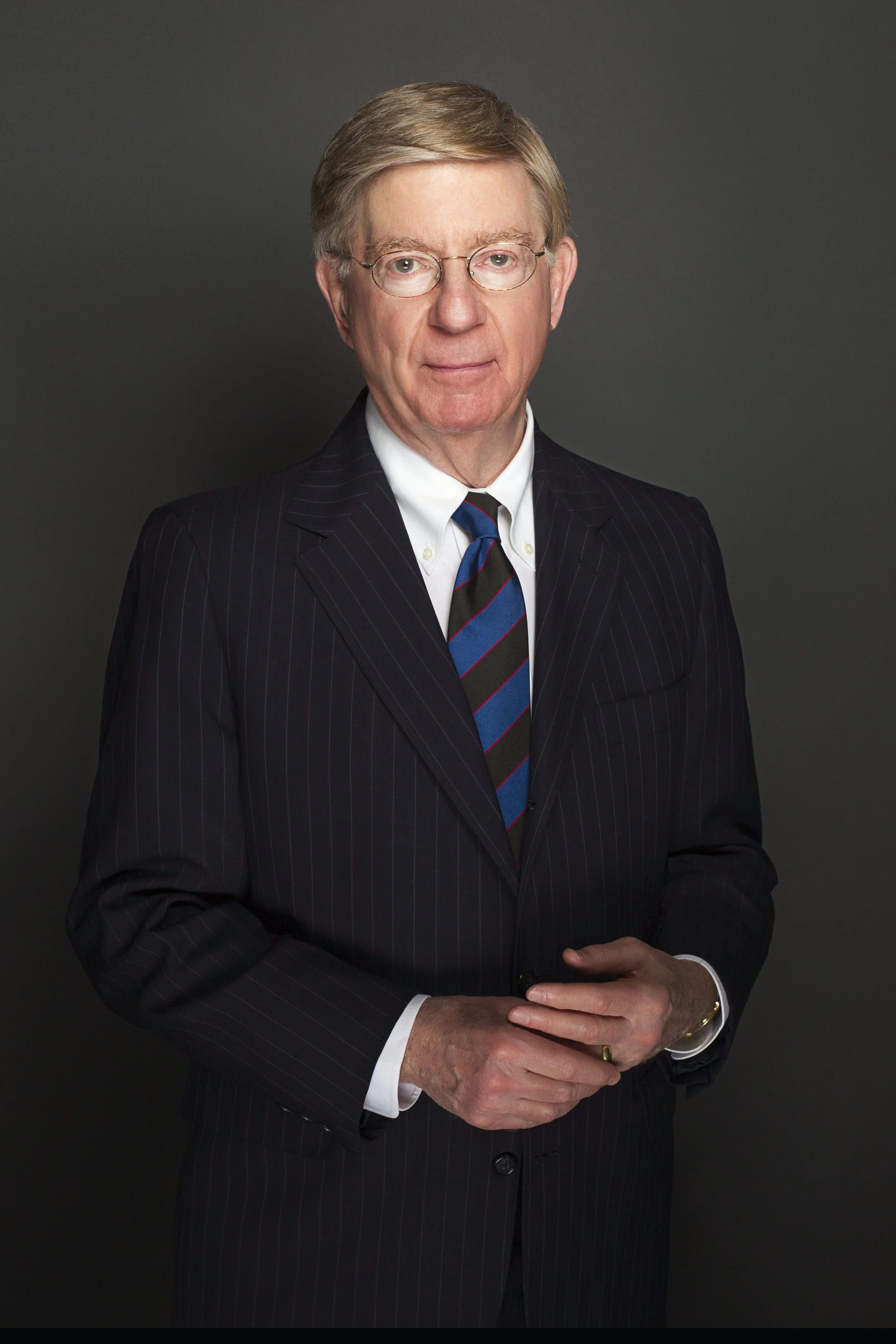
George Will is an American columnist.
750 Words
Contents
Max Raskin: I wanted to start with your actual process of writing. You carry around a card in your pocket to write down column ideas. Where did you pick up your writing process? Did you self-consciously copy someone like Murray Kempton?
George Will: I made it up as I went along. I started very young as a columnist. I was born in '41 and I became a columnist in '73, so I was 31 and a half years old.
I have a strict adherence to a 750-word limit. Murray would sometimes write 675 words, but he was such a literary craftsman that he could do that and get his point across.
MR: Do you handwrite? Computer? Dictate?
GW: Computer.
Believe it or not, I did write longhand with a fountain pen until January 1995. I remember that because baseball was in the strike at that time. The World Series had just been canceled…
MR: …the Expos were on their way, right?
GW: The Expos had the best record in baseball when the season was canceled.
But one morning in January, I did This Week with David Brinkley and then walked across South Street to the Mayflower Hotel — or tried to walk across the icy street — where the baseball strike talks were going on, fell, broke my arm. John Kasich, congressman from Ohio, future governor, drove me to the hospital. I came home and pointed to my wife's computer and said, "Show me how to turn that on." And since then, I've been writing on a computer.
MR: What kind of fountain pen did you use?
GW: Montblanc.
MR: Are you fastidious about your writing equipment or notebook or anything like that?
GW: No. I used to be, but now I'm thoroughly converted to the computer, so I'm not fastidious at all.
MR: Did you ever self-consciously style yourself after any writer? Did you ever try to copy their syntax or anything like that?
GW: No.
What I learned from Murray [Kempton] was that you could make demands on the reader. That is, you could have syntactically complicated sentences. You have to do that anyway if you're going to cover a serious issue in 750 words. You have to assume a certain store of knowledge on the part of your readers, and you have to assume a willingness to read things more complicated than “Who, What, When, Where, Why, How. See Spot Run. Goodnight Moon,” that kind of stuff.
We now have, I'm afraid, an American reading public that is a) small, b) getting smaller, and c) used to undemanding syntax. That's part of the problem with the supplanting of a written culture by a culture awash with graphic images that are undemanding.
MR: What do you think about H. L. Mencken?
GW: I think he's ruined a lot of promising writers.
MR: Why do you say that?
GW: Because they try to write like him, in that tone of voice. And the tone of voice was okay for him, but he wasn't a very attractive person and his tone of voice, it's easy to overdose on it, I think.
MR: So you’ve said before that you don't use social media, and one of the reasons is you're not a fan of the brevity. But you have so many great one-liners. I’m thinking of your view that football is a mistake because it, “combines two of the worst features of American life — violence, punctuated by committee meetings.”
And you also talk about the impact of Reagan’s pithy “There you go again…” line at the 1980 presidential debate.
GW: Yes.
MR: Have you ever considered publishing a book of epigrams?
GW: Yes, I actually have thought I could. I'm approaching now, if I haven't already reached it, 7,000 columns over the last 50 years. I could go through and pull out what you're calling epigrams, sure. It might be fun, actually. I'll think about it.
MR: Did you ever think about putting those epigrams on Twitter?
GW: No. First of all, I don't tweet. I don't like the company you keep when you're online like that…when you're on with people like that. People who have a very compressed attention span.
Reading, Writing, and Listening
MR: I want to ask about audiobooks. Do you read a hard book anymore?
GW: I do still read a hard book, but most of the books I read, I read by listening to them.
MR: Do you listen to them on regular speed, or do you listen to them fast?
GW: It depends on the reader who's narrating the book, but generally I speed it up a little bit. I'm listening to one right now at 1.4x. I had it on 1.5x when I started it this morning and dialed down because I was missing some things.
MR: What's the book?
GW: It's a book called Congress at War: How Republican Reformers Fought the Civil War, Defied Lincoln, Ended Slavery, and Remade America by Fergus M. Bordewich. And it's a terrific book.
Look, I get up at about 5:30 AM every morning. By 5:32, I'm listening to a book.
MR: What does your morning routine look like?
GW: Well, I shave, shower, groom myself, do some errands around the kitchen, and clip the papers before I drive to my office in Georgetown. By the time I get there, I've been listening to a book in two hours of otherwise wasted time.
MR: Do you drink coffee in the morning?
GW: I do. Decaf. I pay a cardiologist to tell me not to drink caffeine.
MR: How do you take your coffee?
GW: Black.
MR: And do you have the same breakfast every morning?
GW: Yes. Honey Nut Cheerios.
MR: What kind of milk do you have?
GW: 2%.
MR: Do you pray? Do you meditate? Do you do anything woo-woo?
GW: No — I'm listening to books. I have an insatiable appetite for words.
MR: Was talk radio ever interesting to you?
GW: No. To me, podcasts are an inefficient way to get information.
Cheeburger, Cheeburger
MR: So our mutual friend Chris Caldwell said that you always eat at one of a few places like La Chaumiere or the Peacock Café.
GW: Correct.
MR: Do you eat the same thing every day for lunch?
GW: No. I'm not obsessive compulsive to that degree.
I long since decided not to be a martyr to the strictures of healthy eating, which is to say I'm still a consumer of cheeseburgers.
MR: What would be your last meal on death row?
GW: In-N-Out Double-Double with a vanilla milkshake and French fries.
Ask me a hard one. I mean, that's easy.
MR: Do you listen to music when you write?
GW: Almost never.
I've got Pandora on my phone, and I've got a good speaker, but normally I don't remember to do that. When I do, it's going to be something like Dave Brubeck. I have a dog named Coltrane.
MR: You’re really into jazz?
GW: I don't know a lot about it. In fact, the reason I named the dog Coltrane and became obsessed with Coltrane is — knowing nothing about jazz — I stumbled on him, and I suddenly could recognize him whenever I came upon him. I didn't need to be told it was Coltrane. So I like jazz.
MR: Do you like Charlie Parker?
GW: Less so. I'm not anti-Parker. Miles Davis, I'm very fond of.
MR: What’s your favorite Ken Burns documentary?
GW: Well, I was a part of his baseball series.
MR: You were also part of The Roosevelts! You were part of many of them.
GW: And Jefferson.
The Major League Baseball Channel, which is about the only television I watch, certainly during the day — during the winter, they play Ken Burns over and over and over again, as far as I can tell.
MR: That’s what we do in my house as well.
But do you have a favorite documentary of his? Do you like documentaries?
GW: Oh, I like the form of it. My favorite is the Civil War, which I think was masterfully done.
MR: Were you a fan of Shelby Foote?
GW: Yes. I read the whole enormous three-volume work.
MR: Who's the character from the Civil War that most interests you?
GW: I'll tell you first who least interests me. I read Professor Guelzo's biography of Robert E. Lee — wonderful biography of an important figure. I came to the conclusion that Robert E. Lee was a world-class bore. He lived through this tumultuous period in American life and as far as I can see, never had any interesting thing to say about any of the issues.
MR: The Marble Man.
GW: Right. Didn't he go through West Point without a demerit?
MR: Yeah.
GW: You have to dislike someone like that.
MR: Well, see, I didn't go to West Point, but I had lots of demerits.
GW: Yes, exactly.
Man at Work: The Craft of Baseball
MR: I promised someone I’d ask you this, but I think the answer is obvious: Babe Ruth or Shohei Ohtani?
GW: Ruth.
MR: What’s the first World Series that comes to mind right now?
GW: Again, let me tell you the one I liked the least — '88. I was writing Men at Work, and I was spending a lot of time with the Oakland A's because of Tony La Russa. They played one of the weakest teams ever to get into the World Series, the 1988 Dodgers. One of the four subjects in my book was Orel Hershiser, the pitcher, who happily for me chose 1988 to a) win the Cy Young Award, b) set the record for consecutive scoreless innings by a pitcher, and c) become World Series MVP. But aside from him, it was a weak team, and they won game one with that walk off by…drawing a blank…the former Tiger…the outfielder who had limped to the plate…
MR: …not Kirk Gibson?
GW: Yes, Kirk Gibson. That's who it was.
MR: Do you enjoy listening to games on the radio or you enjoy watching them?
GW: Well, there is a wondrousness to radio. I think radio is really an underestimated influence on modern life, more than television, more than the internet, even. Radio was the first thing that annihilated distance between the government and the governed and changed the way we think about presidencies and all kinds of other things. But baseball on radio is wonderful because you can do other things while you're listening to it.
MR: If you were to paint an ideal baseball game for you, what is it? Where are you watching?
GW: Season tickets along the first baseline, maybe four rows up from the first base dugout.
MR: Why not on the dugout?
GW: Because I want a slight elevation. You see the unfolding plays better.
MR: What are you eating?
GW: Hot dogs. I love hot dogs. And again, I know they're hideously bad for you, and I only eat them at ballparks, but I eat only them at ballparks.
MR: And how do you take your hot dog?
GW: Yellow mustard, period.
MR: Do you have strong aesthetic views about things like someone putting ketchup on a hotdog or ordering their steak well-done [this is how I take my steak]? Is this something you have an instinct about or are you very laissez-faire?
GW: I'm laissez-faire in the sense that do what you want. I've got a strong libertarian streak, but I wouldn't really trust someone who put ketchup on a hotdog.
Normally, I never would've trusted anyone who tied a Windsor knot, but I think Ronald Reagan did, so I gave him a pass.
MR: What knot do you tie?
GW: Four-in-hand.
Up With a Lemon Twist
MR: What's your relationship to alcohol?
GW: A warm, friendly relationship.
MR: Will you have a beer at the game?
GW: No. I never drink a) before 6:00 and b) I don't want alcohol to cloud my immediate appreciation of what I'm watching in the night game.
MR: Do you ever drink and write?
GW: No.
MR: What’s your favorite drink?
GW: A gin martini.
MR: How do you take it?
GW: Up with a lemon twist. Four parts gin to one part vermouth.
MR: What do you think about people who put all kinds of things in their martinis — olives, blue cheese, garlic — what’s your view of that?
GW: I think they ought to order a salad and not call it a martini.
To my mind, “vodka martini” is an oxymoron.
MR: There’s the story about Churchill’s martinis — he would pour the gin and then bow in the general direction of France…no vermouth.
GW: Yes. He so hated Roosevelt's martinis that he'd sidled over to a plant and pour the martini into it.
Columnizing
MR: Where do you think you’ve come up with the most ideas for columns in your career as a writer? The shower? Listening to the news?
GW: I'm not going to give you a very satisfactory answer because the fundamental fact about me is I'm never not a columnist. 24 hours a day, I'm a columnist. I think I probably dream columnizing. Every book I read, I read with a column in mind, hoping to get something out of it…I usually do. I write 100 columns a year.
If someone said, "Will, what are you? What do you do?" I suppose I'd be expected to say I'm a writer, but actually, I'm a reader. I spend more time reading than writing.
The columns appear on what are called the “opinion pages,” but I think my columns are unusually heavy with facts. One of the nicer compliments I've ever received was from a fact-checker at the Washington Post who said, “I’d no idea how many facts were in your columns ‘till I had to check them.” I think part of the pleasure of reading a column, part of the pleasure is learning things.
MR: So I write sometimes for the Washington Post. I guess between us we must write 100-plus columns a year for them.
Mark Lasswell is now my editor and it's very exciting that I get to work with him because he’s your editor.
GW: He's a very good editor. Very good.
MR: I don't want you to throw anyone under the bus, so is there anyone dead who edited you, who you just you loved?
GW: Well, I liked being edited at National Review, for the three years I was with them, by Priscilla Buckley, Bill's sister. She really produced the magazine.
The second-best compliment I've ever received was when I just started. About two years into being a columnist, she said that if my copy arrived at her desk with no byline on it, she'd know it was mine. I had a tone of voice as an author.
MR: You mentioned Murray Kempton — can you tell me a little bit more about his influence on you?
GW: All I knew about Murray was the following: When I came east from Illinois to go to college at Trinity College in Hartford, I got on the New Haven Railroad, now deceased, and came down to look at the big city. Plunked down a nickel, which is what the New York Post cost then, read Murray Kempton and said, "Wow, what fun he's having and what fun it is to read him!"
That's important because a columnist who isn’t fun to read isn't going to survive because there's nothing in the world more optional than reading a syndicated column. And the world grabs Americans by the lapels and shakes them 24 hours a day with advertising, news bulletins, talk radio — everything clamoring for Americans' attention. They're only going to read a columnist if a) they like the columnist's mind and how it works and b) it's fun.
Notecard
MR: Have you played around with ChatGPT?
GW: Nope.
MR: And why is that?
GW: I think artificial intelligence is another oxymoron. I think ChatGPT is artificial cleverness. When Big Blue defeated Garry Kasparov, that's not intelligence, that's cleverness. That's something a machine can do. I'll believe in artificial intelligence when a machine — when ChatGPT — writes Middlemarch.
MR: Are you interested in technology?
GW: I'm not a technophobe, and the nature of modern life is we rely on technology without really being interested in it. We get on airplanes, big aluminum shells, and are hurled across the sky. I have no idea how they fly. I have no idea. We just trust them.
MR: When you get an idea, where does the kernel of it go? Do you email it to yourself? Do you dictate it into your phone or something?
GW: I have half a 3x5 card in my pocket at all times where I just jot down column topics that I want to get to. I've never been without the card, and I've never been without a column topic.
MR: What’s on the card in your wallet right now?
GW: Hold on [takes out card]. One, it just says Chicago. I'm going to go to Chicago and meet with the people at the Illinois Policy Institute.
MR: It just says Chicago?
GW: That's all. Chicago.
The next thing says Fed. I'm finishing a column right now on the Federal Reserve and after this I will do that.
The next item says USAF — that's the Air Force. I'm eager to write about the problems the Air Force is having.
Another one says geothermal. I want to go out and see one of these geothermal places.
Another says equity training. The equity training we inflict on people, teaching them how to think about…not teaching them how to think, teaching them not to think, teaching them to regurgitate…this passes for current wisdom regarding diversity, equity, and inclusion. A number of legal cases are percolating along now, wherein courts are asked to, and often do say, that this equity training violates the First Amendment as compelled speech.
Building Friendships
MR: I want to ask about Bill Buckley. Was he really like that in real life? Or when he got behind closed doors, he would crack open a Bud and say, "Oh thank God I’m done with that crap for the day — where are my sweatpants?" Or was he really like that?
GW: He was really like that. What you saw was what you got. That was the real deal.
MR: I guess of all the characters you've met in your career, who stands out?
GW: The best was Pat Moynihan. In 55 years in Washington, the greatest delight of moving here was to get to have him as a friend.
MR: I worked in the Daniel Patrick Moynihan courthouse for a year — what’s your view of architecture?
GW: I like what Pat, more than anyone else, did to improve Pennsylvania Avenue. When the Germans bombed the House of Commons and Churchill superintended the rebuilding of it, as it was not to be improved, he said, "We shape our buildings and our buildings shape us." No question about that.
MR: From Bauhaus to our house?
GW: Yes, exactly. The brutalist architecture of the '70s and on, the Department of Transportation in Washington, the odious J. Edgar Hoover FBI building on Pennsylvania Avenue. All of these are terrible.
Writers Today
MR: I want to ask you about the writers that you read today. Is there anyone's column that you can't miss? Or an author whose book you read immediately when it comes out?
GW: Well, start with the author. It used to be when Elmore Leonard published a novel, I'd drop whatever I was doing and go get it.
Today, there are a lot of really good young writers out there, two of whom worked for the Washington Post — Megan McArdle and Jason Willick. The third is Dominic Pino. These are just really good people.
MR: Do you read anything that's really off the beaten path? Blogs or anything like that?
GW: No.
John Cochrane of the Hoover Institution who blogs as The Grumpy Economist, I read him regularly. A few others.
MR: And you really don't do Twitter at all?
GW: At all. I don't know how. If you pointed a gun at me and said, "Tweet or I'll shoot you," I'll get shot.
MR: Well, I hate to tell you this, this is actually what's coming up in the future. They will tell you to tweet or they will shoot you.
GW: Probably.
George Will’s Favorite Things
MR: You said you don't watch TV. Are you a fan of movies?
GW: Not really. I haven't been in a theater since one of my children made me take them to Les Misérables. I don't expect to ever go to a theater again.
I like movies and I see them on television. I do watch television — I watch on BritBox and I think Netflix does a lot of good stuff.
MR: What are your favorite movies?
GW: Well, let's see. Driving Miss Daisy. Glory. Interesting, both of them star Morgan Freeman. Witness, one of my favorite movies. Shane with Alan Ladd. And probably When Harry Met Sally.
MR: Is there anyone that you want to talk to that you, George Will, can't talk to? What does that process of interviewing someone look like for you?
GW: Say it was a senator, I'll send an email and it will get lost in their communications shop. Excuse me, most of these young people running these comms operations are trying to prevent their senators from communicating.
In a normal administration, I would’ve, by now, tried to go and see the Secretary of Defense and the Secretary of the Treasury. I can't do this with the Trump people because I'm too toxic.
MR: But do you think you could get to Taylor Swift if you wanted to?
GW: Good question. I don't know.
Free Will
MR: Are there any topics that you think are too personal to write about?
GW: Yes — me.
I decided about 25 years ago never again to use the word "I" in a column. And I have now got to the point where I quit reading a column when I encounter that.
MR: What was the straw that broke it?
GW: Oh, I don't know. It's just such lazy writing. There are a few columnists, and I'm not going to mention them, they often begin their column, "I…"
You can't get through the first paragraph without encountering that several times. And those are people who don't know how to write.
MR: But there are also people like E.B. White and the personal essay. You really want to shy away from that?
GW: Well, right now, I'm writing my memoir, in which I have to write about me. Part of the reason I wanted to write my memoir was people said, "Please do it," but also it's a writing challenge.
MR: Are you thinking about a title for it?
GW: No. I’ve written 16 books and I usually get the title at the end of writing with one exception. I had the title of my best baseball book, Men at Work, before I wrote a word, because I really wanted to write a baseball book that was not boys of summer gush. I wanted to say baseball is not boys at play. This is men at work, and it's a hard and dangerous business.
MR: Do you have a faith in God?
GW: No. I don't believe there is a God.
Look, if someone says, "Well, Will, how do you explain the universe?" If you want to posit a first cause and call that first cause “God,” go ahead.
Deism seems to me to be not a religion. A religion should do three things: It should explain, it could console, and it should enjoin. And deism does none of those things.
MR: And what about the afterlife? Do you believe in an afterlife?
GW: Nope.
MR: Do you believe we're essentially just monkeys walking around?
GW: No.
We commonly use the phrase, “I have a body.” Actually, I am a body. The most amazing thing that we know of so far in the universe is between our ears. It's the human brain.
It's astonishing that approximately three pounds of matter stores the fact that Ted Kluszewski, in the 1950s, first baseman for the Reds, three times hit 40 or more home runs and struck out fewer than 40 times. Now, I don't know why that's up there. I'm glad it is, but that's more amazing than anything else we know about the universe.
MR: This was who?
GW: Ted Kluszewski.
MR: Oh, I thought you said Ted Kaczynski.
GW: No.
MR: They called him Big Klu, right?
GW: Yep.
MR: I think I heard you say once that you're thinking about hanging it up after 7,000 columns. Do you think about your father and how long he lived and his mental acuity? How do you think about aging and keeping your mind sharp?
GW: Well, I don't know how you keep it. I think that's genetically dictated.
MR: You don't do anything? You don't drink cod liver oil or something like that?
GW: Nope. I have a 53-year-old Down syndrome son who has Alzheimer's. Turns out that Downs people in their 50s — about 80% get Alzheimer's. We didn't know that until recently because not enough of them lived into their 50s. So as we cope with that, there's really not much coping to do. You just accommodate it.
MR: Do you do crossword puzzles or Sudoku or anything like that?
GW: Nope.
MR: You write, that’s what you do.
GW: That's it. And I'm never not a columnist.
MR: Andy Ferguson expressed awe of you. He thought that Walter Lippmann was the only one who came close to you. He’s said to me he suffers from very intense writer’s block, but he’s just the most amazing stylist — I think of him as a writer. I’m obviously not putting myself in your category, but I think of us as typers. Once I get an idea, I have to hold myself back. It just flies out of me.
GW: Yes. Writing is a physical tactile pleasure, putting together paragraphs.
MR: I can't tell you how much fun this was. I hope I asked you some questions that you don’t get asked very often.
GW: You did. And I enjoyed this. I really did.