


Jacob Kaplan is a writer, actor and comedian.
The Color War General
Contents
Max Raskin: This is going to be a very biased interview because I’m such a fan of summer camp and the concept behind what you did.
I want to start with music. Do you have memories of summer camp and music from that time?
Jacob Kaplan: Definitely. I think that the actual music in the movie isn't all the exact same songs from camp, because we can't afford that. But there are very specific songs that I think of, music I learned at camp—stuff that's personal to me, but also general camp songs.
MR: And what are some of the songs? Just any association that pops into your mind.
JK: Honestly, the first song I think of is "The General" by Dispatch.
MR: Me too. I used to play that at summer camp.
JK: That is the classic. And it's funny, because I'm 28, and when I was at camp, it was the late 2000s, early 2010s. So it was a little past Dispatch's biggest era. But it was a time where the counselors, back when they were campers, were like, "Dispatch is the single biggest—"
MR: I used to play that song at open mic at our camp all the time. That was my song.
JK: "The General" I think of as camp. It is the number one.
MR: Why is that?
JK: I was talking about it with a friend of mine who's much a more musical guy. It must be something about Dispatch's reach to Jews specifically, or New Yorkers, or people in the Northeast in the early 2000s, something like that. I can't speak to it with any authority, because I feel like I came a little bit after the rise of it.
MR: But what is it about that song that appealed to us so?
JK: You can play it on guitar, like you said, and stuff you can play on guitar is easy for camp. And vocally, it's not too difficult.
MR: And I guess Green Day's "Good Riddance" was another easy guitar song.
JK: Yeah, that's a real classic. Maybe I just apply the same rules I think make for a good karaoke song, which is a chorus that everyone knows and verses that the singer can take on their own. That would be my first guess.
MR: So when you look back at your memories from summer camp, what jogs your memory? Do you have pictures? A diary? Email? What did you do to get in the headspace of summer camp?
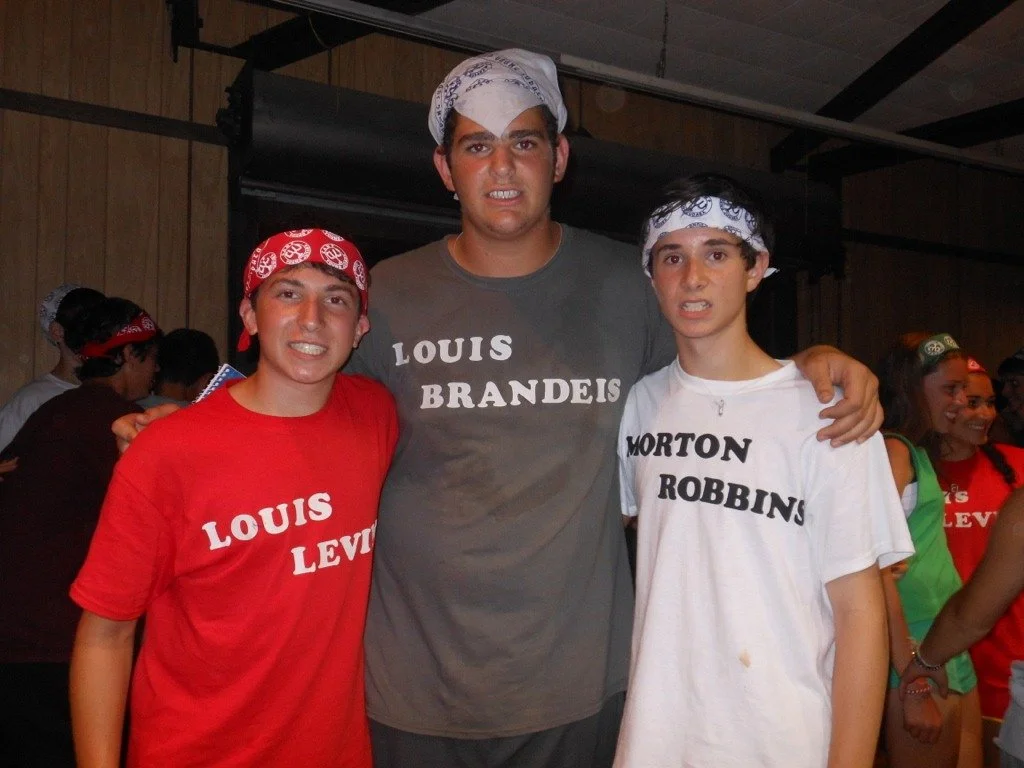
JK: Most of the records I have are from the older years, when I was 13, 14, 15, which is slightly older than the campers in this movie. I tried to write down what I could when I was there at the time, but it's tough to have that foresight when you're a kid. I definitely would look back at a lot of pictures from when I was 14, 15. And one thing is just the bizarre camp outfits people wear. You're never wearing normal clothing. You're always monochrome because it's either Color War or some other thing like that. Weird costume pieces are so much a part of camp.
MR: What were the clothes that stick out in your mind from summer camp?
JK: I think of a lot of pinnies or sleeveless shirts.
MR: For me, I would wear Birkenstocks, and it's incredible that it's come back so strongly.
JK: Yeah, Birkenstocks for sure.
MR: I feel like visors were even a thing in summer camp.
JK: It would always be that one year, there was one weird clothing thing that everyone was adopting. One year it was those sunglasses that flip up with regular glasses underneath, or a bucket hat, or some sort of weird visor thing.
MR: Flannel pajama pants were a big thing.
JK: Well, because so many people would have them from, like, "I had a blast at Sophie's bat mitzvah" or something like that. You'd wear the merch that you got.
MR: Yeah, you were at Sophie's bat mitzvah too?
JK: I was there. Yeah, yeah. Oh my God, I had a blast.
MR: I didn't have such a great time.
Summer camp interests me so much, but now everyone's going to be talking to you about it. Are you sick of it by now?
JK: I'm not sick of it. I'm certainly not sick of it.
MR: Are you allowed to say you're not sick of it?
JK: It's funny, I did an interview a couple days ago with my writing partner, and we were like, "We're done talking about summer camp." And afterward we were like, "Eh, maybe we shouldn't have said that."
Salute Your Feature Films
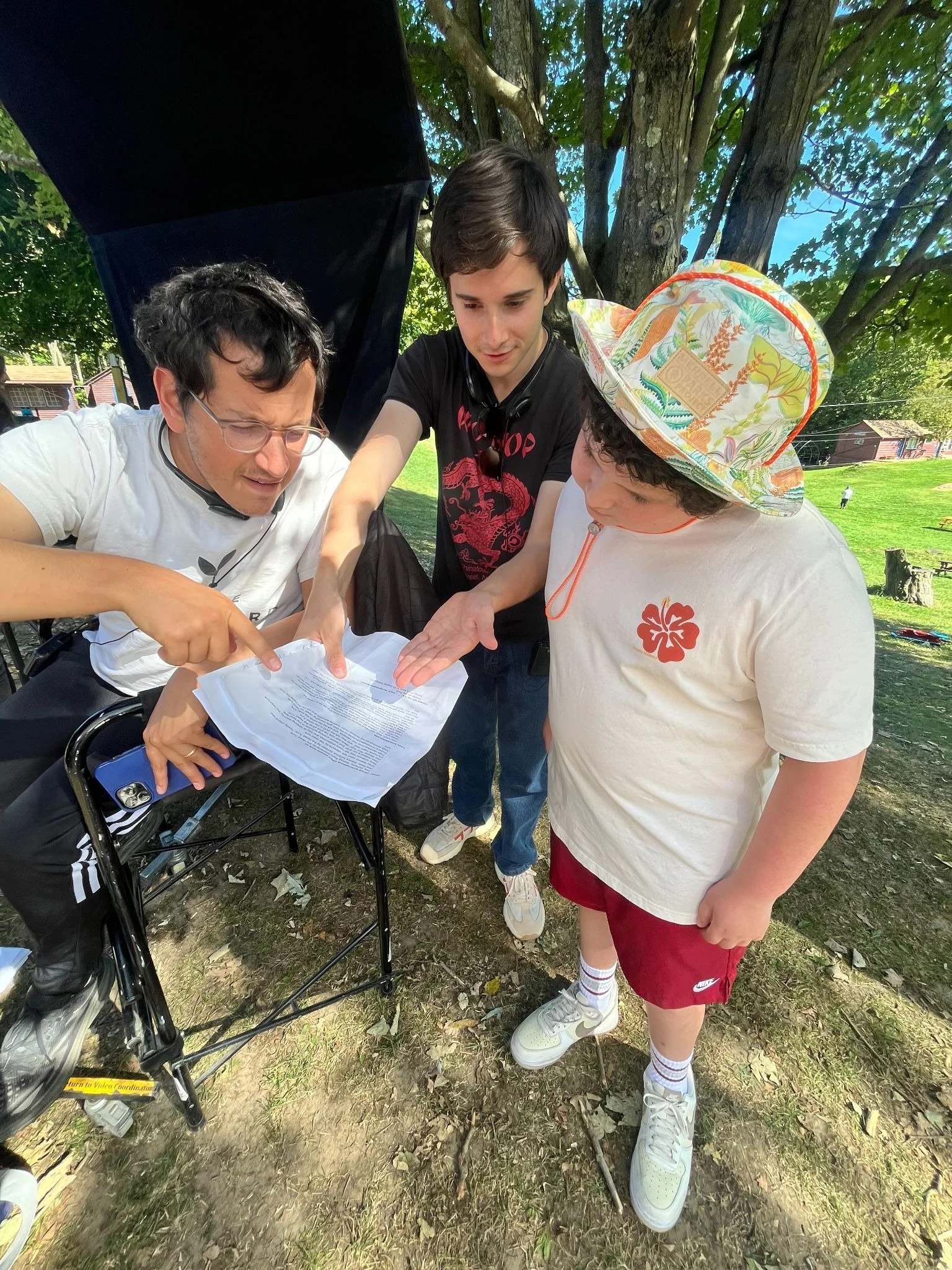
MR: So I'm just going to ask you a lot of summer camp questions.
JK: Hit me.
MR: What are the summer camp movies that stick out in your mind?
JK: Wet Hot [American Summer] is probably the first one that comes to mind. That's one of my favorite comedies. Our movie is not exactly the same tonally…that's a much more wacky movie, and I love that.
MR: Yours is Superbad meets Wet Hot American Summer.
JK: Yes, and when people watch it, it definitely is more on rails. I think it'll feel more like Stand by Me than Wet Hot American Summer.
MR: Do you think Wet Hot American Summer is too avant-garde?
JK: No, I don't think Wet Hot American Summer is too anything.
MR: Would you describe it as an avant-garde movie?
JK: I would have to put myself back in 2001 and see how it felt when it came out.
MR: Napoleon Dynamite was avant-garde, right?
JK: Yes. If anything, I would put Wet Hot more in the Naked Gun, Airplane! camp. Not that it's a spoof, but just sort of slapsticky, doing bits, not breaking the fourth wall. But I just think Wet Hot American Summer is so specific to what it is. It comes from such a real place of what its subject is about.
But the humor is very goofy. One of my favorite bits in all of comedy is that in Wet Hot American Summer, anytime somebody throws anything offscreen, the sound effect they use is glass shattering. You throw a book and it's glass shattering. It's all that stupid, dumb stuff, but I think it's hilarious. But yeah, Wet Hot is a great one.
MR: Did you go back and watch Salute Your Shorts?
JK: I've never seen Salute Your Shorts.
MR: Interesting. Why not?
JK: I don't think I know Salute Your Shorts.
MR: Really? It was a really popular TV show for Millennials.
JK: It’s TV — I guess that's my out. I feel like I checked all the movies off the list.
MR: What about Moonrise Kingdom?
JK: I actually saw it when I was at camp, funny enough. It's definitely an inspiration, I think, for a lot of the more emotional parts of the movie. I guess the feeling of solitude you get when you're at camp, or being away from your family, and we took inspiration from that for the relationship between Johnny Knoxville and the main kid.
MR: Is the main character based on someone real, with a real name? My friend told me it's his actual name.
JK: So it's funny. We took the name Jacob from me, and then Udell—the guy I wrote it with, Michael, knows someone named Jacob Udell. It was not at all based on him as a person. I don't know the guy at all, but I do know there is a Jacob Udell somewhere out there.
MR: My friend is friends with him.
JK: Is he?
MR: He went to [college withheld for privacy] with him.
MR: The main character is obviously Jewish.
JK: Yeah.
MR: How does being Jewish fit into all of this?
JK: It was always a Jewish camp when we were writing it. I went to Jewish camp, Michael went to a Jewish camp, and that was the DNA of the movie. But as we got into the process of getting it made and wanting it to have as big an audience as possible, there has been a big question of how Jewish do you make the movie in a way that's still going to be accessible to other people? And I think more than anything, you don't want all the jokes to only make sense if you went to Jewish summer camp, or you're not going to cast a very wide net. And I very much believe in what I guess you could call the Adam Sandler school of putting Jews in movies, which is that the characters are Jewish, but it's not the main focus of the movie. So it's all to say, it is a Jewish camp.
MR: What's an example of something you took out? Or what's an example of something that wouldn't necessarily play for a broader audience?
JK: This is in the movie, actually. A big part of the movie is that they escape to the original location of the camp so they can hide out there forever. They open up this decades-old fridge to see what's in there, and the only thing inside is 40 bottles of old Manischewitz. So it's stuff like that.
Or similarly, when one guy is about to throw an Axe bomb—which is a classic camp thing where you take your Axe body spray and light it on fire—to blow up the fridge, just to cover his bases and count his lucky stars, he says the Shema. I really love that kind of stuff in there. And hopefully the Jews who watch it will get it.
Summer Camp
MR: Let me ask you the million-dollar question: What is it about summer camp that you love so much? And what is it with this fantasy of being able to go back there?
JK: It’s such a good question. I can think of my answer as a kid, which was that it was this world where, for the only time in your life, you get to have autonomy. When you're a kid, you don't really get to do anything. You go to school, your parents pick you up, and you're just moved around from place to place. Camp was the first time in my life when I got to, in a way, call the shots. Or at least feel like, "Oh, I'm not part of this unit with my family where people are bossing me around." You get to be your own person.
MR: How much of that is tied up with romance?
JK: Just having a camp girlfriend and stuff?
MR: Yeah, especially for Jewish people who grew up in non-Jewish places.
JK: When I think of girls and dating at camp, what I think about is the freedom to be able to hook up with people. When you're in school, when you're 13, 14, you can't drive anywhere. You can't really even have a girl in your house unless you have super cool parents or whatever. It's sort of just an impossible thing to do, other than, like, "Oh, I'm going to kiss a girl at a dance." So I think that is part of the autonomy and part of feeling like an adult.
The high school I went to was very Jewish, but I think there are a lot of people for whom the good thing about camp is that it's the only time they're around other Jews.
MR: That was very much the case for me.
JK: And where did you go to camp?
MR: It was called Cedar Lake Camp.
JK: Separate from this movie, I did a stand-up tour with a friend of mine a few years ago where we only performed at Jewish sleepaway camps.
MR: Did you go to Cedar Lake?
JK: We didn't go to Cedar Lake. But we did go to this camp in Mississippi called Jacobs—Henry S. Jacobs Camp—a Jewish sleepaway camp deep in Mississippi. And as you can imagine, the kids who go there are usually the only Jews at their school. It felt like a different vibe than my own camp in New Hampshire, or a camp in New York, where you're going from one very Jewish area to another.
MR: How do you capture whatever that amazing experience of camp is? It's the first time in my life I really understood the concept of rose-colored glasses. I close my eyes, especially in the summer, and I look back at that time in my life, and there's literally a feeling of warmth, golden warmth, that rushes over me. Can you get that back? Can you get that in regular life?
JK: I think it's a matter of whether you're able to roll some of those moments into your regular life. That's very much the message of the movie: You can't do camp forever. My favorite line in the movie—I guess I'm biased because I wrote it—is toward the very end, when Johnny Knoxville's character says to Jacob after the whole plan has been foiled, "Part of what makes camp magic is that it ends."
MR: Do you think that's right?
JK: I mean, yes, it's definitely a thesis that I believe in. It's like anything where the finite—the idea that camp is an escape from your regular life—is part of what makes it so special and so magic. The lack of responsibility, the lack of accountability, is part of that magic. And I think it's impossible to fully replicate that in your life. But you can try to absorb moments from that experience and take the spirit of camp, the spirit of whatever you want to call it: freedom, buying in, carefree joy.
MR: What do you think about communal living? This is going to sound crazy, but I visited my summer camp this year with my wife and kids. I saw the schedule on the bunk, and I wrote it down. And I thought to myself, "I should have a schedule in my regular life that's like the summer camp schedule," and I've been trying to figure out how to do it.
But I guess my point is, you have this thesis that it's the scarcity that makes the thing valuable—it's the finite amount that makes the thing valuable. But do you think maybe it's the communal living, combined with never having to think about what you're eating…let’s call it kibbutz-style removal of choice to make people happier. Do you think that has anything to do with it? Do you have any fantasy that you would go live on a kibbutz now, or whatever the American equivalent of a kibbutz is?
JK: I don't think it's something I'd be looking for now. I totally see the similarity there, and I think there is something to a community where everyone is really speaking the same language. And I think about this a lot, having gone back. There are positives and negatives to it. There's very little diversity of opinion at camp. Everybody loves the same stuff. We all agree, we buy into the idea that everything is amazing. Or if it's the other camp, we all hate the other camp. And I think that is part of what makes it such a special place, a special thing to be part of. I don't think that's something I would be looking for in my life now. But at the time, I do think that's a big part of what made it feel like such a specific, unique community.
MR: Is there any other music that pops into your head from that time?
JK: I mean, there are definitely the classic camp songs. There's "Sweet Caroline." There was a lot of weird late-'90s stuff: some Spin Doctors, like "Two Princes," or Third Eye Blind, "Jumper." Those were big songs we would sing at song session.
For myself also, of all places, Jewish camp is really where I got introduced to rap, because I never really listened to rap at school or among my friends. And I do feel like there's a big thing with Jewish boys listening to rap.
MR: Can you rap all the lyrics to a certain song?
JK: Definitely, yeah. Nothing cool, but "The Real Slim Shady," definitely. It was a different time, but a ton of Kanye. We listened to a lot of Kanye. Jewish boys love the clever lyrics.
Color War and the Salvation Army
MR: What do you think about Color War?
JK: Well, I'll preface this by saying I was a captain, and captain of the winning team, no less. Still a proud achievement.
MR: What team were you on?
JK: So it was the white team.
MR: Ah, white. I was always on blue. Let’s stop the interview now.
JK: We actually had six teams. I know some camps have two.
I think the biggest part of Color War, the thing everyone was anticipating the whole summer, is who's going to be picked as a captain. Because the camp picks the captains, and it's campers who are the captains. So it's kind of this first moment where you're like, “Oh, who…?” It's the same thing as Oscar buzz, or even who's going to win an election.
MR: There’s a leadership aspect to it. It's fascinating. The joke I make is that Color War and the Salvation Army are two things that, if you didn't know what they were, would sound very scary.
JK: Totally. It’s tough to say, "I was leader of the white team for Color War."
MR: And the Salvation Army sounds like they are slitting throats somewhere in the Great Plains.
JK: Completely.
MR: I’m overwhelmed — I have so many questions to ask you about summer camp. Do you stay in touch with your friends from camp?
JK: I do, especially as this movie has been coming out. Actually, I have a save-the-date on my fridge from one of my camp friends.
MR: Did you have a girlfriend during summer camp?
JK: Oh yeah, of course.
MR: Did you stay in touch with any of them?
JK: There was one I kind of tried to stay together with after camp, but she lived in Boston and I lived in DC. It was not meant to be.
MR: Do you stay in touch now?
JK: No, I'm not in touch with any of them. Not on principle…
MR: …do you have any interest in reaching out?
JK: I think that one of them is engaged.
MR: You think?
JK: I think.
MR: You don't think, you know.
JK: I say “I think.” I know.
Yeah, maybe someone told me she was engaged. I did see one was engaged. It's also kind of a funny thing: You feel so passionately and strongly about these people, and then you zoom out and you're like, "Oh, this is a person I knew for six weeks when I was 14."
MR: So how do you reconcile those two things?
JK: Reconcile which?
MR: Summer camp is such a strong emotional part of who you are. At least for me, it's such a strong part of who I am. But it takes place over the course of eight weeks over four summers or something like that.
JK: I was up at my camp this summer. I was filming some content to put out around the release, and it just so happened to be Color War when I was up there. And I remember going through the day—waking up, breakfast, lineup, all the Color War events, the evening activities, whatever—and it being 10 p.m. and me thinking back, "How did we do this all in one day?" You really pack so much in. And to that schedule idea, at camp you are just doing so many things at any given point, and you're just on, and you're active at all points.
Every moment, other than maybe literally when you're sleeping—and even then maybe not—is the chance for some interesting, funny, exciting memory or thing to happen. And I think that is at least part of how you stretch that time to make it feel longer.
MR: It’s like the Lenin essay from 1918 where he says something to the effect, "There are decades where nothing happens, and there are weeks where decades happen."
JK: Yeah, and at camp, they say every day is a week—that's sort of the camp adage. But I think that's part of it. The other part is maybe that communal living thing you're talking about: You just get so close with these people, and there are these bonds, and there's this, I'd say, safety, or comfort to be vulnerable with each other. And I think that helps as well.
Frindle: The Motion Picture
MR: What kind of pranks did you play at summer camp?
JK: It's funny…I hate getting in trouble. That's probably the biggest difference between me and the main character in the movie. But I will say one prank, which was a very Jacob Kaplan-y prank: One summer, my friend and I decided we wanted to make up a word, spread it around camp, and have everyone believe it was a real word. The word we came up with was stignatious, which we decided meant super cocky. Like, "That guy's really stignatious."
We were both Color War captains, and we both put the word into our speeches, and it started to spread at camp. No one knew it was a fake word; everyone thought it was real. And for me, the apex of it was when some counselor turned to a kid and was like, "Stop being so stignatious." We were like, "Do you even know what that word means?" And she goes, "Yeah, I'm an English major."
MR: That reminds me of this book called Frindle—
JK: Frindle is my single favorite book! One of my lifetime ambitions is to make the Frindle movie.
MR: You want to write it together?
JK: I have been trying to get the rights for years. Oh my God.
MR: Are you serious?
JK: My writing partner, who I did the movie with, also loves Frindle. Basically, every year, we make a play for Frindle.
MR: I'll do it with you. Okay, that's going to be where our interview ends, because I think we're on the same wavelength in life. Okay.
JK: I want to do the Frindle movie. If you have any way to get the rights