

Interview with Leland Vittert
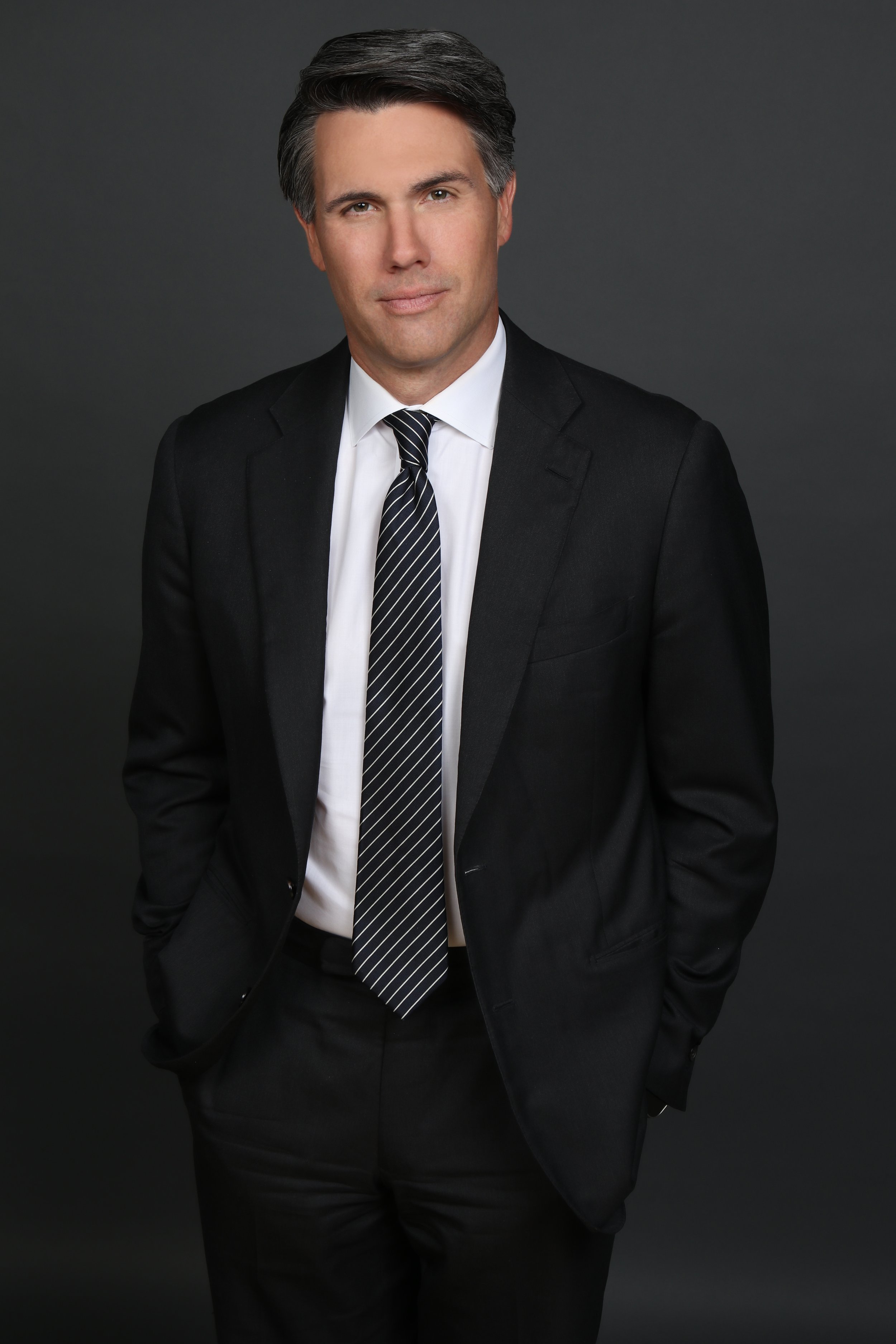
Leland Vittert is a journalist and news anchor.
Traveling with Uncle Ben
Contents
Max Raskin: I want to start by asking about the two flags behind you — but especially the tattered flag. What is that?
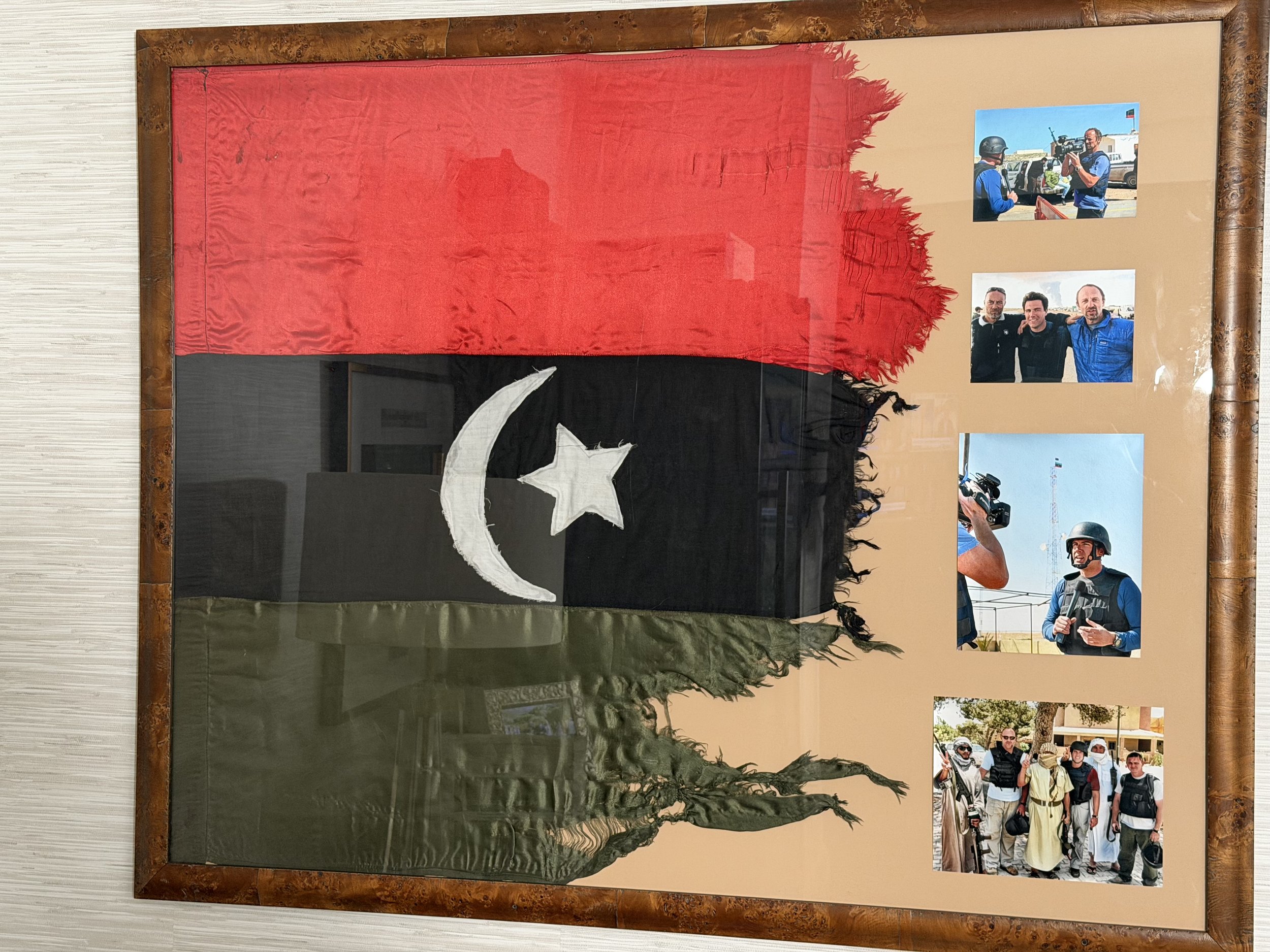
Leland Vittert: That is the flag from a Libyan rebel checkpoint outside of a town called El Agheila. I was there when it got bombed.
It was the last rebel checkpoint before the front lines. This is during the Arab Spring before the no-fly zone, and we spent all morning there. One of our security guys looked at me at about noon and he said, "We need to leave right now." And my photographer and I looked at each other and we were like, "Right now? We have a couple more things to get done."
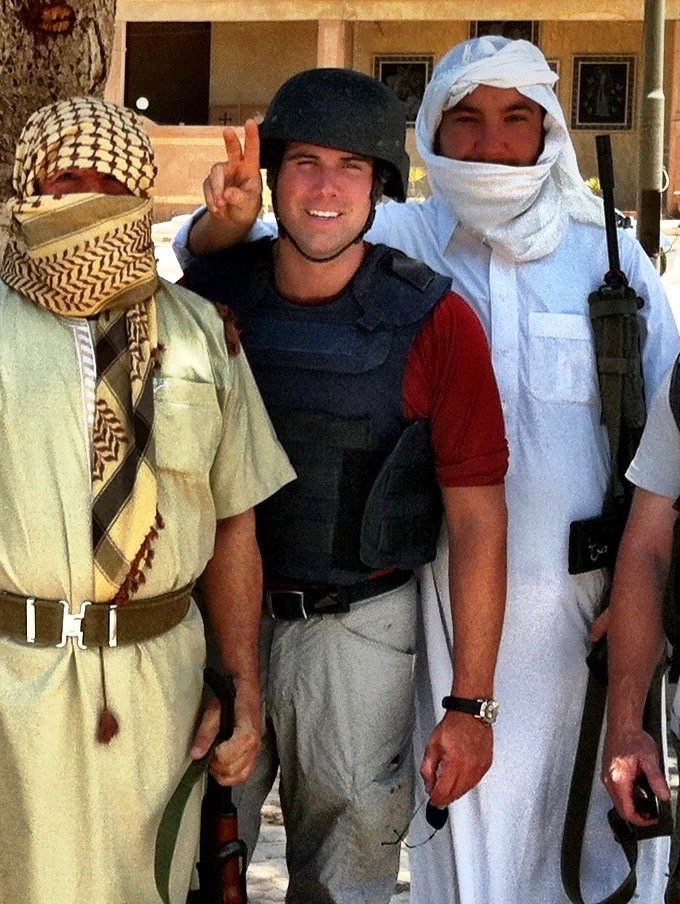
And he said, "Right now," and grabbed our flak jackets and started pulling us by the grab handles towards the truck and just threw us in the truck. We drove about a hundred yards back and a Libyan jet flew over and bombed the checkpoint and a bunch of people got hurt, a bunch of people got killed. And the next day I went back and I got the flag.
MR: Other than listening to your security, do you have any travel tips?
LV: I always carry a lot of cash, but when I was a foreign correspondent, I carried five- and six-figures worth of cash in places. I don't do that anymore, but there's a lot of problems that Uncle Ben can solve. Always carry cash. Especially when I'm traveling, I stash $100 bills in weird places.
Also, I always carry a pretty extensive med kit.
MR: Do you have one you recommend?
LV: I built my own. I used to carry enough drugs for an emergency room, but now I just carry a very, very broad range of travel meds.
MR: Do you have a backpack you like?
LV: I carry a backpack by a company called GoRuck. The GR2 is my run bag.
How to Win Friends? Write a Note.
MR: As a reporter, how do you keep track of your contacts?
LV: Really boring — I use the iPhone contact list.
MR: Do you put notes on people as you meet them?
LV: Yes — for you, I would put, "[Name withheld’s] friend," something about your newsletter. I would add little notes that way.
MR: How many people are in your phone book right now?
LV: 3,300. But I'm very, very big on handwritten notes.
I have three different sets of stationery in front of me right now.
MR: Where's your stationery from?
LV: The cheapest stationery. Stationery Studio — because it's actually as high quality as Crane and it's about a fifth the price. And they have the nicest customer service. The value of a handwritten note used to be high, now it's gold.
MR: Who's the last person you wrote a note to?
LV: The people whose house I was a guest at over the weekend. But every person I've done an interview for the book got a handwritten note.
MR: Where did you pick up the habit?
LV: High school, I don't know.
MR: Did you read How to Win Friends and Influence People?
LV: So that's actually in my book. My dad said it was the Bible. I never really understood it. My dad was able to internalize it and understand it. Part of Born Lucky is that I really couldn't, so he had to tutor me about the minute social fabric and emotional understanding that most people have. That if they read How to Win Friends and Influence People they go, “Oh, a-ha!”
I wasn't there, so I really needed him to do this really intricate, in-depth tutoring on that.
I just always found that writing a handwritten note is a really great touchpoint with people. People always say it’s so old-fashioned and a waste of time. I ask them when the last time they got a text and they’ll say, “three weeks ago and it was the greatest thing ever.” Wouldn’t you want someone to have that response about you?
All in the Family
MR: Are you obsessive about anything? Like trains? I used to know all of the batting averages of everyone on the New York Yankees from 1997 to 2001. Do you have anything like that?
LV: That would require me to be way smarter than I am. No.
MR: Do you think you're a smart person?
LV: No, not particularly. I mean, my sister went to MIT and graduated with a degree in pure math.
MR: I’ve seen you interview her a few times — is that strange?
LV: No, it's great because she can't fight with me. Normally, she fights with me and makes me look stupid, but she can't do that on TV. It's great.
MR: What do you guys fight about?
LV: Anything. She's my sister. Put two drinks in front of us and we'll find something to fight about. But one thing about Born Lucky that I think is really important is how our family came together and it was us against the world.
My parents didn't tell anybody about my diagnosis. They didn't tell anybody about my problems or my journey. I had no accommodations. I had no extra time to test. I had no behavioral plan, nothing. And they didn't tell my sister, but my sister knew I was getting bullied and everything else. She was known in school as the retarded kid's sister. That's what everybody called her. And so it created this fierce, fierce family loyalty of us against the world.
So we fight and we scream at each other, but if 15 minutes later you need something, you can text and even though we may not be talking, we’ll still do it.
Eight Hours
MR: Do you have any apps on your phone that other people might not have heard of?
LV: It’s going to sound silly, but I have this thing called Eight Sleep. It's an app that controls this thing that's on my bed.
MR: I heard of it…one of my other guests swore by it.
LV: It is the best very expensive purchase I've ever made.
MR: That’s what they said too.
LV: A friend of mine told me about it. I was like, “I cannot spend this amount of money on some water-cooled mattress pad. This is absurd." And one morning, my wife and I woke up having not slept and both being hot because the dog is a furnace. I decided to order the thing because it had a 30-day or 30-night guarantee. So it comes in these two huge boxes. I unbox the thing, I put it on the mattress, set it up, and then I really carefully pack all the boxes back up so I can return it if I need to return it.
The next morning, I woke up and threw the boxes away.
MR: It's that good?
LV: It's that good.
MR: Do you have any fitness wearables or anything like that?
LV: I used to have an Oura ring. All it told me was to sleep more and drink less. I know this already. What's funny is I asked a number of other people who have Oura rings, some really high achievers, and they said that’s all it ever tells you to do.
MR: It's hard to be in good shape when you're a journalist — other than the walking, you are drinking and eating a lot, right?
LV: Yes. Although having a 9:00 PM show curtails both of those things.
MR: Do you consider yourself a journalist or a TV man?
LV: I am a news guy who does an opinion show.
MR: Would you ever go back out into the field again?
LV: There's no better place than the field. Reporting, to me, is by far the best thing I can ever do in my life.
MR: Are you basically always wearing a suit and tie?
LV: Yes.
MR: Where are your suits from?
LV: My suits are from a tailor in Hong Kong that I used to go to, and he now just keeps making them.
MR: And ties?
LV: Wherever my wife gets them.
MR: If you were going to interview President Trump, what tie are you wearing?
LV: Oh, I'd probably wear the tie that my wife got me to get married.
MR: What kind of shoes do you wear when you're working?
LV: Oh, that's a fun one. For dress shoes, I only wear a cowboy boot brand called Lucchese. They're the most comfortable shoes I've ever had.
MR: Oh, wow. Are you tall?
LV: No, I'm 5'11".
MR: So they give you a little lift.
LV: Let's put this away. I buy mine off the rack. I do not have the Ron DeSantis special.
Anchors
MR: Who's someone who you have not interviewed that you're trying to get?
LV: Elon Musk.
MR: Who are some of your favorite interviews?
LV: I love Jillian Michaels. I think my favorite two guests I would have to say are George Will and Bill O'Reilly, just because they're two giants and geniuses in their own rights. To be able to interview them and have them as part of the show has been really the coolest part of being a primetime anchor.
MR: Who were some of your news and TV influences?
LV: I would say Jennings, Brokaw, Rush Limbaugh, Bill O'Reilly, and Rachel Maddow. That'd be my list. And I would say in reading, George Will.
MR: All of those people are institutional and pretty mainstream — do you consider yourself mainstream?
LV: I don't know what that means.
MR: I guess I’m thinking in contrast with people like Rogan.
LV: Let's put it this way —I try really hard to hold myself to old school journalistic standards, which I think makes me passé. The thing about podcasting or tweeting is you can just do whatever you want. You can just publish whatever you want.
Scott Pelley said something really wonderful — in a world where everybody's a publisher, nobody's an editor. And I try really hard to hold myself to the old school standards…of having an editor. My executive producer still holds me to those kinds of standards. So even though it is my show and I can say what I want, I try to look at it through the lens of being an old school journalist.
MR: Do you look at guys like Cronkite with admiration?
LV: Yes. To me, Jennings is still held in reverence. And Cronkite too.
MR: I notice you have a Sharpie in your hand.
LV: I normally always have a Sharpie in my hand.
MR: You use a Sharpie for everything?
LV: Yes. This is the fine tip Sharpie, and then I have the other one.
MR: What do you use when you’re out in the field?
LV: Normally when I'm in the field, I use just a reporter's notebook and an ultra-fine point Sharpie.
MR: It doesn’t give me the ink I need.
LV: Maybe I don't write enough.
MR: Do you nap?
LV: I'm like Forrest Gump — I sleep when I'm tired, I eat when I'm hungry. I probably don't nap. When I was in the Middle East, I napped a lot more because my work schedule was so much more chaotic because you had to report during the day.
MR: What's the best domestic airline to take?
LV: Delta.
MR: What's the best international airline to take?
LV: I think you'd have to say Singapore, but I don't really get to Asia that much. For Europe, I either fly Swiss or Lufthansa.
Missourah
MR: Do you floss?
LV: My wife buys those little stick things.
MR: What time do you go to bed and what time do you wake up?
LV: I go to bed anywhere between 11:00 and 1:00, 1:30 sometimes, and I'm up normally by 7:00.
MR: What's your favorite restaurant in DC?
LV: Probably Le Diplomate.
MR: The place you order from most?
LV: Jetties sandwiches.
MR: Do you have a go-to order?
LV: I think it's called a Nobadeer. Basically, it's like a Thanksgiving dinner and I add bacon and sweet pickles.
MR: Are you religious?
LV: No. I grew up as a religious mutt, but I would say I'm spiritual.
MR: Did you have a religious practice?
LV: No.
MR: Do you go to church or anything like that?
LV: No.
MR: What does it mean to be a religious mutt?
LV: My dad grew up Jewish, but not really a practicing Jew because he was part of the Jews that were more Americana. And then my mom grew up Christian Scientist but left the faith.
MR: You’re from St. Louis — how do you pronounce Missouri?
LV: “Missour-uh.”Fun fact is that politicians in Missourah, which is what I call it, used to cut two sets of commercials. They used to cut for the St. Louis and Kansas City market, Missouri and then they would cut Missourah for Rolla and Joplin and Cape Girardeau.
MR: You won an award for your hair, right?
LV: Yeah, which is weird. You can do anything — you can break major stories, you can force people to resign…
MR: Have you ever forced anyone to resign?
LV: I feel like when I was younger, there was some fire chief or something.
But you can do all these things. I've done a hundred plus interviews for the book — no matter what I’ve done — I interviewed the founder of Al-Qaeda's brother, I've gotten beat up by Antifa — I've done all this stuff in my life. And the only thing everybody universally says is, "Oh, you have the best hair award from Denver in 2007."
MR: Is it just because it's on your Wikipedia page?
LV: I guess, and I don't know how it's there. I don't even know how Wikipedia works, so I have no idea how to change my Wikipedia page. But somehow that is the go-to question that everybody has. I don't want to say joke of an award, but it was a very backhanded compliment in Denver to get this award for.
MR: Where do you get your haircut?
LV: Wherever my wife goes in Georgetown. I think it's called Izzy Salon. I don't know. I have the guy's number saved in my phone.
Book Club
MR: If you were going to interview yourself and research your own book, what is something people did not pick up on? What did people miss?
LV: Was my mom actually in the CIA or not? Which I don't know the answer to, but that was something that was left unresolved in the book because I don't know the answer to it.
MR: How many people do you think read the book who interviewed you?
LV: Actually read the whole thing? 40%? Maybe less, 30%. Literally from almost the first sentence, you could tell whether someone had read the book or not. It was really illuminating for me — don't interview people about their books unless you've read the book.
MR: Or interview them not about the book.
LV: Right. But if you're going to interview somebody about their book, read the damn book because otherwise you suck. Not that you're a bad person, but your ability to interview somebody about a book that you haven't read reminds me of when I was in high school and you tried to fake your way through English class by reading three chapters of the Iliad the night before.
MR: Me and my friends had this book club where it was all the classics like Moby Dick. The only rule was you couldn’t read the book. So you had to just use context clues from what you knew about the book from life. “What did the whale represent?” But you couldn’t actually read the book. There’s actually a book called How to Talk About Books You Haven't Read. I obviously haven’t read it, but the idea completely changed my life.
LV: That’s my kind of book club.