

Interview with Rabbi Yitzchak Breitowitz
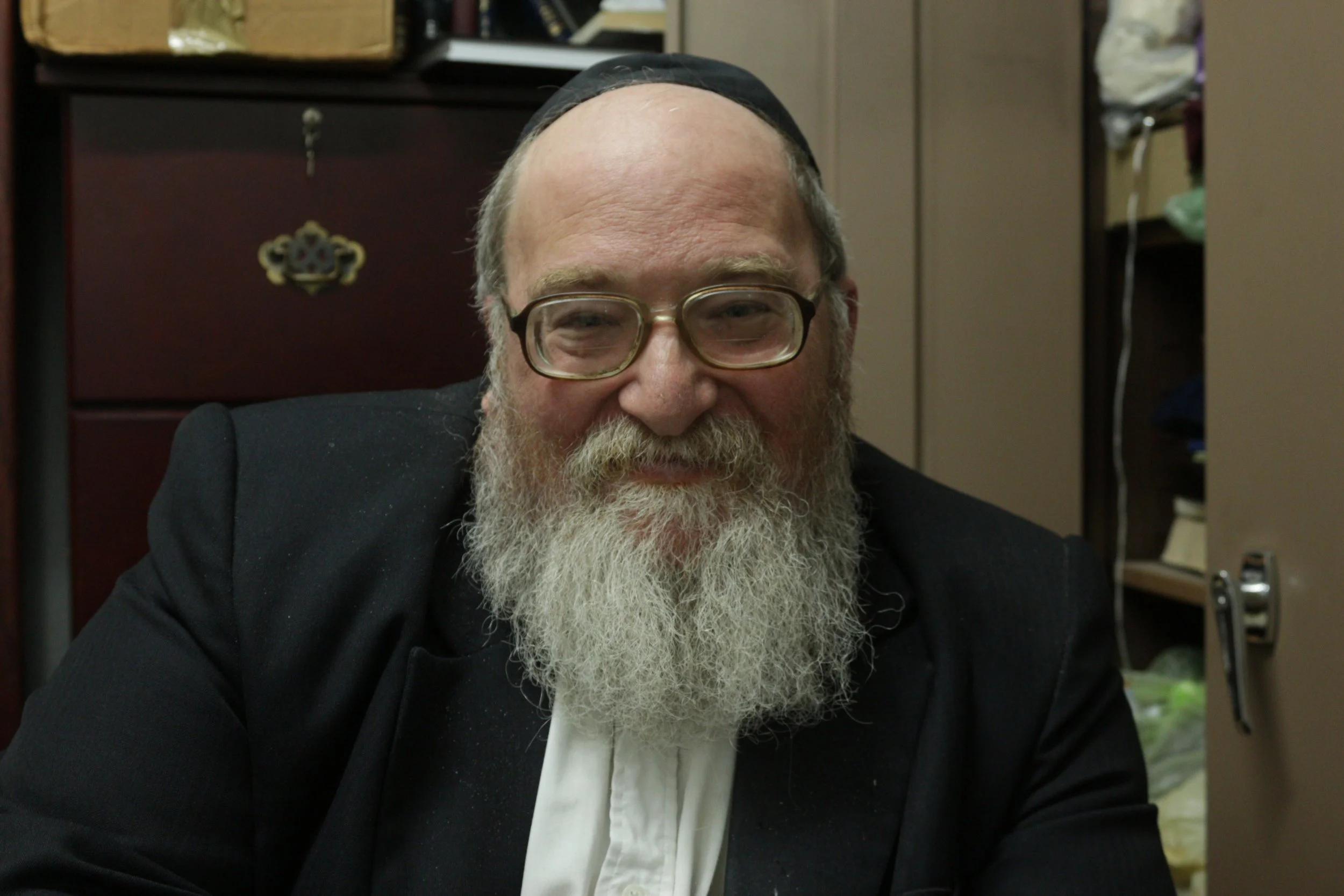
Rabbi Yitzchak Breitowitz is the rabbi of Kehillas Ohr Somayach in Jerusalem.
Reading and Writing
Contents
Max Raskin: I want to start with books — when you are reading do you take notes? Do you write directly in the margins? How do you actually read?
Rabbi Yitzchak Breitowitz: I do both. I do underline things in the book and make little, short marginal notes. If it’s a longer observation I want to make, I'll have a separate sheet of paper and the like. But I find it helpful to actually write in the book itself, at least if it belongs to me, because that way as I read the book, I'm able to remember and integrate whatever thought or observation I had at the time.
MR: Do you use pencil or pen?
RYB: I use pen usually.
MR: You use pen?
RYB: I use pen because even a hava amina [initial thought] has some validity. Now, you're right — sometimes as I'm writing, I'll change my mind, and I'll say, "ignore above." I probably should use pencil, but my custom has been pen.
MR: When you come up with novel thoughts do you write it down? Do you send it to people? Do you just sit with it?
RYB: I don't send it to people. I try to write it down. Unfortunately, my organization's not as good as it should be. I used to try to keep it in a series of notebooks, but then the problem is I'm learning in a different place without the notebook. So as a result, it's tissues, napkins, slips of paper. If I have time, I do try to put it in a more permanent form, but sometimes not. I'll show you a lot of tissues if you ever come and visit me.
MR: I'm interested in the interplay between study and teaching. How much of your time do you spend teaching and preparing for teaching, which I know is a kind of learning — and how much time do you spend learning just for Rabbi Breitowitz — with a chavrusa or just yourself?
RYB: I don't spend enough time on my own learning. The point you're making is a very excellent one that I myself tell people all the time who become rabbis and go into chinuch. You have to have a core of learning that's just for you — that's not connected to your classes, that's not going to even be a teachable subject. That's going to be your growth in your learning. And that in turn will energize you, it'll keep you enthusiastic, and it'll prevent the burnout.
Every teacher knows that, essentially, they only need to be one step — 10 pages — ahead of their students. And as a result, there is kind of a yetzer hara, not to really push yourself to a high level of mastery. But if you have a vocation that you really love, and it's independent of any professional responsibility of teaching, I think that can energize you a lot more. At least that's what I found myself.
As a result, I find that I often gravitate to subjects that have absolutely nothing to do with what I teach. So for example, I happen to be very interested in Seder Taharos and the introduction of the Rambam to Seder Taharos. I have never had any occasion to teach that anywhere…although I'm thinking maybe I should find some avenue. I often tell my wife, "I'm learning something that has nothing to do with the class." And I'm saying it in a positive way. I don't have as much time to do that as I would like, but I do consider it to be a very, very important component of growth in Torah learning.
MR: Do you have a chavrusa where it’s not one of your students but someone who you are either equal to in learning or they’re greater than you?
RYB: There were times where I had kollel guys that I would learn with, but in recent years, I have not. The schedules don't work out so well.
And sometimes, to be frank, some of the things I'm interested in, it's hard to find people that happen to share the same interest. So I tend to be a bit of a lone wolf when it comes to that learning. Aspects of Seder Taharos or even Nevi’im and Kesuvim I'm very interested in going through to get a fundamental grounding, which again, there's not that much of a demand in the yeshiva kollel world for that type of study.
Maybe I shouldn't say this, but I am not that interested in subjects that are actually quite important in my line of work. I do it when I have to do it, but that's not the thing I want to learn.
I do not enjoy proof discussions, like “what are the proofs of God?” or “how do you know the oral Torah was given to Moshe?” These are questions I get every day and I have to talk about them, but I have no intellectual interest. I also find that the discussions tend to be nonproductive since those who want to be skeptical will just continue to be so. By definition, emunah [faith] issues are not mathematically demonstrable and proofs are never iron-clad. They are probabilistic and should not be over-hyped.
Rabbis
MR: Who were your rabbis?
RYB: First and foremost was R’ Yaakov Ruderman, the rosh yeshiva of Ner Yisroel.
MR: Rav Feldman gave the same answer!
RYB: Yes — well, he's older than me, but yes, we’re both students of R’ Ruderman.
Then R’ Yaakov Moshe Kulefsky of Ner Yisrael. He taught me how to say a shiur, prepare a shiur, and explain a beautiful, logical, and artistic structure.
And then I have to say that I consider some of the teachers I had growing up before I even came to yeshiva as having a very pivotal influence in my life. The rabbi of my Young Israel in Hartford had an incalculable influence in my life. My seventh and eighth grade teachers, I still treasure what they gave me.
MR: What was your level of observance growing up?
RYB: It’s a little strange. When I grew up in my early years — my parents had left mitzvahs because of the war — so I became a baal teshuvah at around the age of nine. My parents sent me to a Jewish day school from kindergarten, and I became religious in a house that initially was not shomer shabbos, but there were so many people who kind of adopted me. And of course, without my parents' support, I wouldn't have had anything. So I do owe everything to my parents. But within the community, there were so many families that gave me shabbos hospitality, that learned Torah with me, and baruch HaShem, my parents eventually also became shomer shabbos.
Those formative experiences had a deep effect on my life and how I approach kiruv. Perhaps because I became frum as a child, warmth, care, and love became more important factors than philosophical hair splitting and endless argumentation. That is my fundamental approach to kiruv to this very day — though obviously I do spend much time in answering and even debating the “big questions.”
MR: Someone told me you clerked for a federal judge — is that true?
RYB: I did clerk for a federal district judge who was a partner in my law firm, so I just went with her. I didn't have to interview with her or anything. And I will say — I hope I'm not breaching confidence — she gave her clerks a tremendous amount of autonomy. So essentially, we wrote the opinions that she would read, and if she thought it was good, she just went with it. There are, in fact, a number of reported decisions that are literally my memoranda word for word, though the judge would certainly not approve it until she read word for word.
Identity
MR: How much do you stay abreast of secular things? Do you read a newspaper in the morning?
RYB: I think I follow things pretty carefully. I don't obsess over them, but I certainly know what's going on in the United States politically, socially, even legally — of interesting Supreme Court decisions or whatever it may be. And obviously I follow what's going on in Israel, where I live.
MR: Do you consider yourself an American or an Israeli?
RYB: That's a hard question. I am a dual citizen, and I think that impacts on my identity as well. I have a great fondness for the United States. I think it was a very, very good haven for the Jewish people. We were able to achieve quite a lot, both economically and socially and freedom of religion, especially. So I have a great debt of gratitude for America. My parents came as refugees from the Holocaust. They were able to make a home and raise their own family there. I'm not one of the people who burns my bridges with my connections to the United States. My only son is in Baltimore, so I do have a strong American identity.
But at the same time, we've been in Israel now 15 years, and we've been through wars and terrorism and intifadas and all sorts of things. Obviously, you build up a very, very strong connection to Eretz Israel, religiously, but also the State of Israel as well. So dual citizenship is an existential reality, it's not just a political nomenclature.
I also think Americans bring some very good values that can benefit Israeli society. Israeli society is highly polarized and conflicts between religious and secular and even between religious groups are often very bitter and divisive. Each side demonizes the other and sees no redeeming value in the alternative view. The American personality tends to be more tolerant, more respectful, more willing to see the valid points made by the other side. This in turn can foster greater cooperation and shalom, something we sorely need.
MR: I know this is not a fair question, but is there a particular book that stands out to you as just kind of mind meld?
RYB: I think there are a few. The Meshekh Chokhmah — I'm often astounded by the brilliance. Rav Tzadok is just jewels of wisdom.
MR: Is there a particular book of Rav Tzadok you would point to?
RYB: There are really three I would mention. Two of them he wrote himself, the Tzidkas HaTzadik, which are short entries, and Resisei Layla, which is also very, very moving about struggle and difficulty. And then the Pri Tzadik is probably the most popular book of Rav Tzadok, but he didn't write it. These are notes people took of his Torah every week. But Pri Tzadik is full of beautiful, beautiful, beautiful thoughts.
And then the Maharal is great, but as I say, different parts of it are more accessible than others. And then I would mention I really love the Alter Rebbe’s Tanya.
MR: There’s a new huge version of Tanya that just came out.
RYB: Please send it to me. R’ Shneur Zalman’s style is very dense. I can't say he's the easiest writer to read, but he's dealing with deep ideas. But sometimes you get it in your stomach. Something just hits you extraordinarily beautiful and moving.
MR: How do you label yourself religiously?
RYB: Well, the label's a little hard because I wouldn't say I am a chassid in the sense that I follow a rebbe, but I’m what Chabad calls a “friend of Lubavitch,” in which I see much, much beauty in the chassidic life and particularly the chassidic teachings. And I try to incorporate it, even though I'm working in a so-called litvish yeshiva, I draw a lot on Rav Nachman, the Alter Rebbe, Rav Tzadok. And on the other side Rav Kook — Rav Kook is technically not chassidic, but he actually has roots in Chabad.
MR: Is Lubavitch the chassidus you have the most connection to?
RYB: It's hard to say. I love Chabad a lot, and I do a lot of speaking for Chabad in different Chabad houses, but I think the whole moshiach campaign has tainted to some degree a magnificent, magnificent legacy.
Personally, that issue does not bother me that much. Theologically, every generation must have someone who could be the moshiach and when the Rebbe was alive, he was certainly a plausible candidate. And even after he died, there are at least some sources that say moshiach can come back from the dead — though a majority say he cannot. But there is no question that the messianic stance has been enormously controversial and has resulted in a denigration of the truly great work that Chabad has accomplished and continues to accomplish. So in some ways I have to distance myself a little bit from it. But in terms of an overall approach to life, generally, I would say Chabad is the closest thing I am.
Giants
MR: But if I were to ask you what you are you obviously wouldn’t say Sephardi or Satmar. Those are clearly not correct. So what camp do you fall in? What’s your strain?
RYB: Well, the funny thing is, my own family comes from Galicia…
MR: …mine too!
RYB: …it was heavily chassidic — Ger and Radomsk. But I would say based on my overall chinuch I have a litvishe yeshiva training with many emotional attachments to the chassidic world.
MR: And what about mussar? Who are some of the rabbis that speak to you in that strain?
RYB: If you're going back to the classic — obviously Rav Yisrael Salanter and the Alter of Kelm. But the more modern people, I would say Rav Elyah Lopian, Rav Dessler, Rav Shlomo Wolbe, and Rav Chaim Friedlander.
MR: Who was your mesader kiddushin?
RYB: So my mesader kiddushin was Rav Shlomo Twerski. He’s the older brother of Rav Michel Twerski. I didn’t really know Rav Shlomo Twerski — it was from the side of my wife who became religious through him. My rosh yeshiva Rav Ruderman was supposed to be mesader kiddushin, but his flight got canceled, so we had to make a last-minute substitution.
This was one of Rav Twerski’s last kiddushins. My wife and I got married rosh chodesh Tammuz and he was niftar Simchas Torah just a few months later.
MR: What's the first kapitel of Tehillim that comes into your head right now?
RYB: 23 [says the first line in Hebrew].
MR: Is that very important to you?
RYB: It is very important to me, especially the verse that says גַּ֤ם כִּֽי־אֵלֵ֨ךְ בְּגֵ֪יא צַלְמָ֡וֶת לֹא־אִ֘ירָ֤א רָ֗ע כִּי־אַתָּ֥ה עִמָּדִ֑י — that in life there are hardships and there are challenges, and there's a lot of times that we're afraid and we're anxious. But if we feel the presence of Hashem, we'll have the strength to walk through the shadow of death. And this is a theme that's very, very precious to me, very important to me. In fact, part of why I gravitate to both Rav Tzadok and Rav Nachman is this is a theme that they address constantly — how a person has to have this emunah in difficult times — they will see not only the light at the end of the tunnel, but they will see the light even within the darkness.
MR: I don’t know how to ask this, but of all the people you’ve ever met, who do you think had the most spiritual whatever? I know it’s difficult to judge someone else’s phenomenological experience, but who just stood out?
RYB: Well, it's hard for me to judge someone's internal state, but as far as what I absorbed, I would have to say it was Rav Moshe Feinstein.
MR: You met Rav Moshe?
RYB: I did meet Rav Moshe Feinstein when I was nine years old.
MR: What was that like?
RYB: It was very amazing to me. I grew up in Hartford, Connecticut, and he would spend two weeks in Hartford as a vacation. I watched him like a hawk because I had never seen such a person before in my life. The way he davened, the way he talked, the way he cared.
MR: What was it about him?
RYB: What hit me was his kindness, his gentleness, his humility, his approachability. On one hand, he was Gadol HaDor. He knew Shas, Shulhan Aruch, knew everything. On the other hand, he was so simple. He was so simple.
I read stories later about him that confirmed what I remembered from my own. One example: he was in the beis medresh at MTJ, and there was a sixth grader who asked him if he could help him with his homework. Rav Moshe just spent an hour helping the kid with his Hebrew homework.
MR: Did the kid know who he was?
RYB: The kid didn't know who he was. He was alone. He was an old man with a beard, so he just asked him to help.
MR: Wow.
RYB: And when people said to him, "Rav Moshe, you could have asked somebody else to help him.” So he said, “Why shouldn't I? I have a chiyuv to teach Torah to anybody who wants to learn it, that includes a sixth grader." And in my own life, he once sent a whole car to pick me up because he didn’t want a fourth grader to walk 4 blocks to school in the rain. Nothing and no one is too small for the truly great.
The Daily Seder
MR: What’s the siddur you use daily?
RYB: I don't have a particular day-to-day siddur — often an ArtScroll because that's what's there. It’s a very good siddur. But when I choose a siddur, I very much like the Ishei Yisrael — it’s a commentary from Rav Yitzchok Maltzan, a student of Rav Salanter, on the Siddur HaGra. It’s a very beautiful peirush.
Rav Wolbe recommends it because a siddur like the Otzar HaTefilos, which is a phenomenally interesting siddur, I like it a lot, but you have 20 meforshim on the page and it's hard to concentrate in davening.
MR: For baalei teshuva, what have you seen works well to keep that fire and spark alive through your whole life?
RYB: The issue of continuing motivation is a very, very big issue for everybody, even people who are not baalei teshuva. But I think you're highlighting a particular problem, and that is we try to make people frum, but then we let go of them. We go on to the next candidate. Now, baal teshuva doesn't have the family support, he doesn't have the networking that a frum from birth person might have. So the kiruv world generally has to be much more sensitive to the fact that you can't just make somebody frum and then leave them on their own. There needs to be a continuing connection.
It's been well understood that what keeps people religious is the warmth and the connection, and the community that is formed. That's the old joke that the rebbetzin’s cholent makes more people religious than the rabbi’s shiur.
MR: It's 100% true. My bubbie’s cholent made me frum. When I first discovered it, it had way more to do with me becoming frum than anything else.
RYB: So as a result, I’m almost a little anti-intellectual in the fact that I consider the community and the kesher and the warmth and the love to be so fundamental to what makes a person frum, that everything else is almost an afterthought, to some degree. So I think what keeps a person going is the sense that they're not alone, that they're connected, that there are rabbis that care about them, and then that can energize a person to learn.
Now, I would also say that a person has to sometimes redefine the way they learn. For example, in yeshiva, we have the emphasis on iyun, and when a person gets into the working world, iyun is often not that feasible for them. It's not practical for them. And yet, if that's the only modality of learning they know, it becomes an all or nothing. They say, "Oh, if I can't do iyun, then what's the point?" That's a big, big mistake because there's still all sorts of ways of learning that you can grow and be very successful even outside of the traditional yeshiva. So people need to have that flexibility to pivot into different learning styles and different modalities.
MR: Is there a sugya that you think you've returned to the most in your life?
RYB: I go back to Seder Taharos a lot. I go back to Tumas Ohel. Ohelos is a very complicated mesechta and I just find it very engrossing and intellectually rewarding. So I learn it and relearn it quite a lot even though I have very little occasion to teach it so far.
MR: How do you carve out time for yourself to learn? What does that actually look like?
RYB: As I say, it's a tremendous challenge. And I will be honest, I don't do as good a job as I should if I would be more disciplined. Inner discipline is a real issue for everybody. I include myself as struggling with that particular problem.
I will tell you that I find a sefer like Minchas Chinuch enormously, enormously, enormously helpful. Minchas Chinuch can give you a jumpstart to iyun — meaning if you were to simply start with the gemara, you wouldn't even know where to look…there's so many different avenues to explore, et cetera. With Minchas Chinuch you can get a concise delivery system of the fundamental holdings of the Rishonim, Achronim, and then you can go back and look them up and get expansiveness and the like. So Minchas Chinuch is a very remarkable sefer that can really help a person in their iyun when they don't have a tremendous amount of time.
MR: That’s a funny title for you because in some ways that’s your mincha — that’s your sacrifice. You’re sacrificing your own iyun learning to do chinuch.
RYB: Very good — the gift you give to chinuch! Very good.
That's very true. But on the other hand, who knows? The Steipler says that when a person tries to give to other people in any type of context, Hashem will allow them to accomplish in fewer hours what would've taken more hours. So if you would've learned six hours and now you can only learn three hours, you'll have doubled the success rate, so hopefully you come out at least the same. That’s what the Steipler once said.