

Interview with Bilahari Kausikan
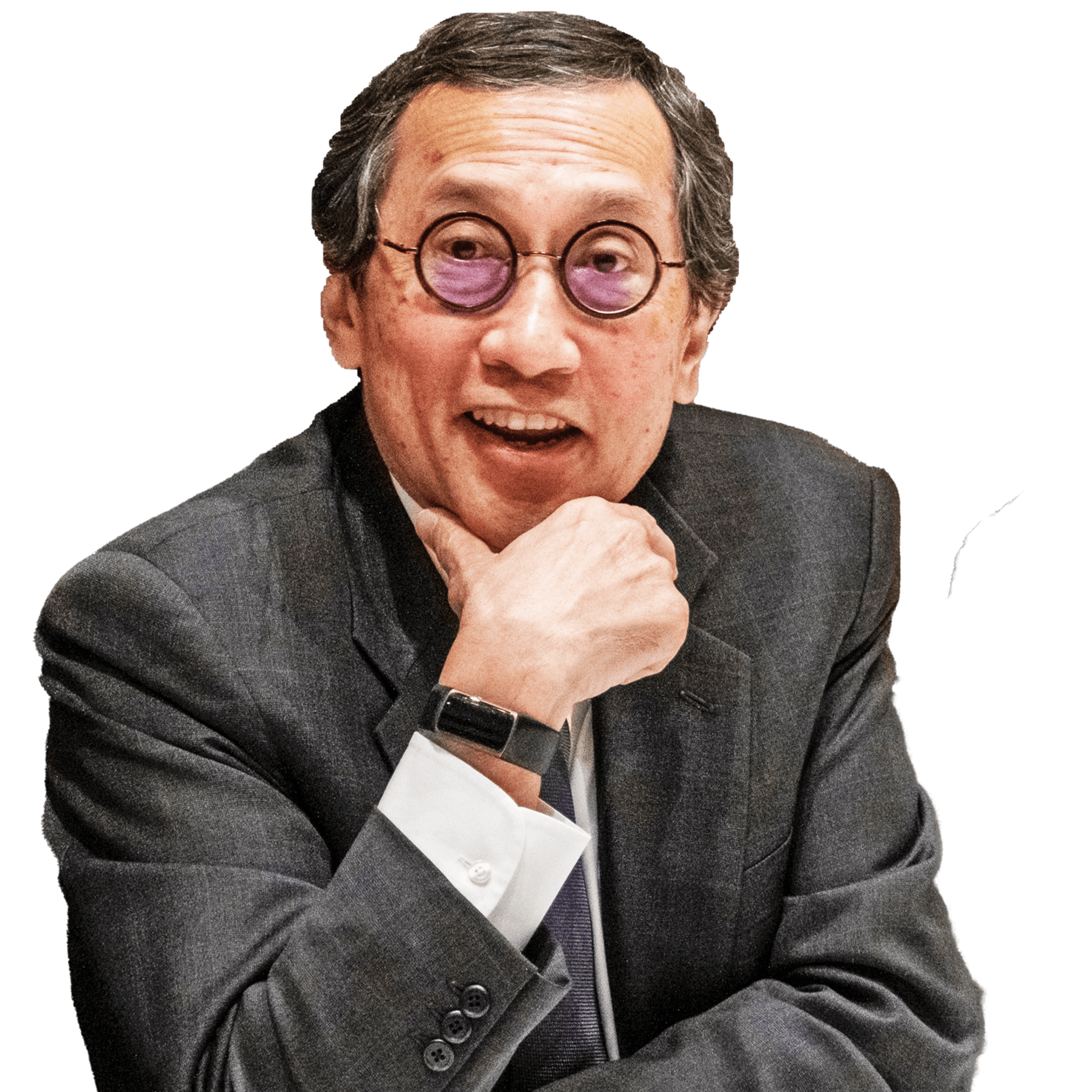
Bilahari Kausikan is a Singaporean diplomat who served as the country’s Permanent Secretary for the Ministry of Foreign Affairs, as well as its ambassador to Russia and the United Nations.
Singapore’s Founding Fathers
Contents
Max Raskin: Did you personally know any of the founding fathers of Singapore?
BK: I worked for them in very minor capacities. I worked for the first foreign minister Mr. [Sinnathamby] Rajaratnam. I worked for Mr. Lee Kuan Yew, taking notes, accompanying him on visits and so on. I worked for Mr. Goh Keng Swee. I knew Mr. Eddie Barker in one project as a young civil servant.
MR: What was it like?
BK: I wouldn't say I knew them intimately, but I served them. I was their subordinate. And I was very fortunate to work for them because I learned a lot through osmosis.
MR: Who made the biggest impression on you personally? Did you feel like you were in the presence of greatness with any of them?
BK: Well, I think I felt in the presence of greatness at least with Lee Kuan Yew, Goh Keng Swee, and Rajaratnam. I think obviously Mr. Lee was the most dominant figure, but as he himself said very often, he was the conductor of an orchestra. He couldn't do it all himself.
They were all very brilliant men. They were all very down-to-earth people. I think the impression I take from all of them, which is a lasting impression, and I tried to abide by it myself, is they were ruthless wielders of Occam's razor. They got to the heart of a problem and cleared away all the fluff. And I think that's very important in diplomacy because half of diplomacy is fluff. More than half, I would say.
Mr. Rajaratnam once very famously said that a country has two foreign policies — a foreign policy of words, that is the theology of foreign policy, and a foreign policy of deed, that is the practical diplomacy. Every country needs both, but for a small country to confuse the two is suicidal. I remember the quote because it’s engraved in my memory, "It's as suicidal as a nun wandering in a red-light area proclaiming the brotherhood of men."
MR: There’s something about Singaporeans that is very frank. How does that develop in a person?
BK: Well, first of all, most other Asian countries, especially in Southeast Asia, consider us something of barbarians for that very reason.
We are direct. We are frank. And I think it's something to do with the fact that we are all immigrants who left much of our traditional cultures behind. All our ancestors came from somewhere else — a bit like Americans in a sense.
Island Religions
MR: Your family is Peranakan Chinese?
BK: My mother's side of my family is Peranakan Chinese. My father is Indian. He came from Madras in Tamil Nadu.
MR: This may be a self-selection bias, but all the Singaporeans I know don't put too much stock in religion themselves. Is that some kind of national necessity?
BK: Many Singaporeans are religious, but I think what you described is part of the social compact of Singapore. This is a tiny place. It's a very diverse place. We speak about Chinese, but there are many different types of Chinese. And therefore, part of the social compact is that religion is a personal matter. We all are ourselves. We are not a melting pot. We don't believe you can create new identities because your own cultural background, your own religious background is part of your identity. But we all have to live together by making some compromises on the margins of these identities, including religious identities. And the sum of that margin is what we will call the common space. And the job of the government, the fundamental job of the government is to defend that common space and expand it where possible.
MR: Do you have a religious practice?
BK: My family is Anglican, but it skips generations and it has definitely skipped me.
I say Anglican because that's how I was brought up. Do I go to church? No, I stopped going to church a long time ago. I was baptized. I was confirmed. I was married in church, and I expect to be buried from a church, but that's about it.
MR: Do you think Lee Kuan Yew believed in God?
BK: I don't think he was religious in the conventional sense, but I think he was driven by a sense of great morality and great commitment. I don't think any of them was particularly religious in the conventional sense.
MR: What about Rajaratnam?
BK: He was totally secular. Now that you raise it, I never even thought about him in religious terms.
Strait News
MR: Whichever one of them you were closest with, what did they read on a daily basis?
BK: I was not close to any of them. But I had a chance to work with Mr. Lee and Mr. Rajaratnam as a subordinate and observing them. They were both voracious readers.
I think they got their news wherever they could get their news. The Straits Times is the primary English language newspaper. I think Mr. Lee at least read the Chinese newspapers or had somebody get them for him. I think they were voracious consumers of information. They read, and it's a rather unfashionable thing these days, but I do know all of them read actual books.
MR: What do you read every day?
BK: I start my day by looking through online newspapers — The Straits Times, the New York Times, the Washington Post, the Financial Times. I also read Nikkei Asia. I look at Caixin Global, which is a Chinese business newspaper. I look at Reuters. I look at Bloomberg. I spend probably the first hour and a half or two hours of the day looking through.
MR: Do you read primarily in English?
BK: I read primarily in English. I can read Malay, but it's a bit of a struggle. But these days, most things are very quickly translated. I'm interested in China, but I don't read Chinese at all. I studied in school not very seriously with the result being I don't read it and I can't speak it well. But nowadays, all the major speeches, say by Chinese leaders, within two days or three days, they are translated.
MR: When it comes to global political analysts today, is there anyone who you think has their finger on the pulse?
BK: There are a number of people whose works I try to follow. I'm also one of those rapidly growing extinct creatures who read books. I like to follow on China, for example, David Shambaugh. Professor Kerry Brown, he's a Brit. I like to follow Edward Luttwak.
BK: He's a friend of mine. I follow whatever is written by another friend of mine, Shivshankar Menon. He was a national security advisor of India under the Congress government. There is a columnist I try not to miss, Mr. Ignatius from the Washington Post, on certain subjects.
Kissinger, Lee, and Agatha Christie
MR: Do you have any predictions about the future that are far outside the mainstream?
BK: There is a lot of wringing of hands, rending of garments, and gnashing of teeth over the so-called disruptions to world order, but I look at it in a long perspective, and I see this as a reversion to the norm.
MR: Did you know Kissinger?
BK: I met him a few times and I have briefed him on things. He was a good friend of Mr. Lee Kuan Yew, and twice Mr. Lee asked me to brief him on things that were happening in Southeast Asia and so on. I must tell you, it made my PhD qualifying orals a breeze by comparison.
MR: Of all the figures that you've met in your career, who do you think is the most intellectually impressive?
BK: Well, without doubt, Mr. Kissinger and Mr. Lee.
Mr. Lee is not an intellectual. He has intellectual interests, but he's not an intellectual.
Kissinger had the same attribute which I told you our first generation had. On the two occasions when I had to brief him, he would begin by saying, "I know nothing about this subject." And I don't think he was selling a lie. And then he'd listen very carefully. You think he's asleep, but actually he's listening. And then he will ask you a question that gets right straight to the point.
MR: The painting behind you is so striking. What is it?
BK: It's by my daughter.
MR: It's very striking.
BK: Yes. It’s supposed to be my wife.
MR: Do you have any artistic ability?
BK: No, not at all.
MR: Do you have any hobbies outside of geopolitics?
BK: Reading. I read a lot of detective stories. Mystery novels.
MR: Who’s your favorite author?
BK: My favorite authors are really nobody contemporary. Ngaio Marsh. I prefer the golden age of detective novels — the 1920s, 1930s, maybe until the 50s. There are a few detective novels that bear rereading. Dorothy Sayers. Raymond Chandler.
MR: Do you put Agatha Christie in there?
BK: Agatha Christie is very good for plots, but not so good about characterization and so on. I find her books interesting but rather thin.
MR: What about music? Are you interested in music at all?
BK: My taste in music stops sometimes circa 1973. I'm pretty tone-deaf.
MR: What are you reading now?
BK: King Dollar by Paul Blustein. It's about the dollar's dominance in the world. It's a good book because there are too many people who have been prematurely predicting the demise of the dollar, and he basically makes a case for why it is very unlikely.
Tocqueville and Technocracy
MR: Is there a piece of your writing that you think is the most indicative of your thinking or that you're the most proud of?
BK: I would point to a long essay I wrote, which is actually an adaptation of a lecture called “Protecting the Core of Singapore's Foreign Policy.” It’s in the book Singapore Is Still Not An Island. There was an earlier collection called Singapore Is Not An Island.
If I'm talking to somebody who is not particularly interested in Singapore, I would say there's an article I wrote for Foreign Affairs called “Navigating the New Age of Great-Power Competition.”
MR: What did you take away from your time in America?
BK: I took away two major things. One is of course a taste for bourbon, which remains to me to this day.
MR: What's your favorite bourbon?
BK: Oh, my favorite bourbon is the one in my hand. Okay? But I'm partial to Maker's Mark.
The second is that America was founded by people who fundamentally did not trust government. And so they made the central government, in particular, as weak as possible — politely called checks and balances.
But in Asia, in every Asian political culture that I know, good government is equated with strong central government.
It's a simple thing. I think most Americans know this. You absorb it with your mother's milk, right? But I think it's not an intuitive idea to most Asian political cultures.
It follows from that — and it took me some time to understand this too — the most important things in America do not necessarily happen in Washington D.C. They happen in your civic associations, in your big corporations.