

Interview with Jacob Rees-Mogg
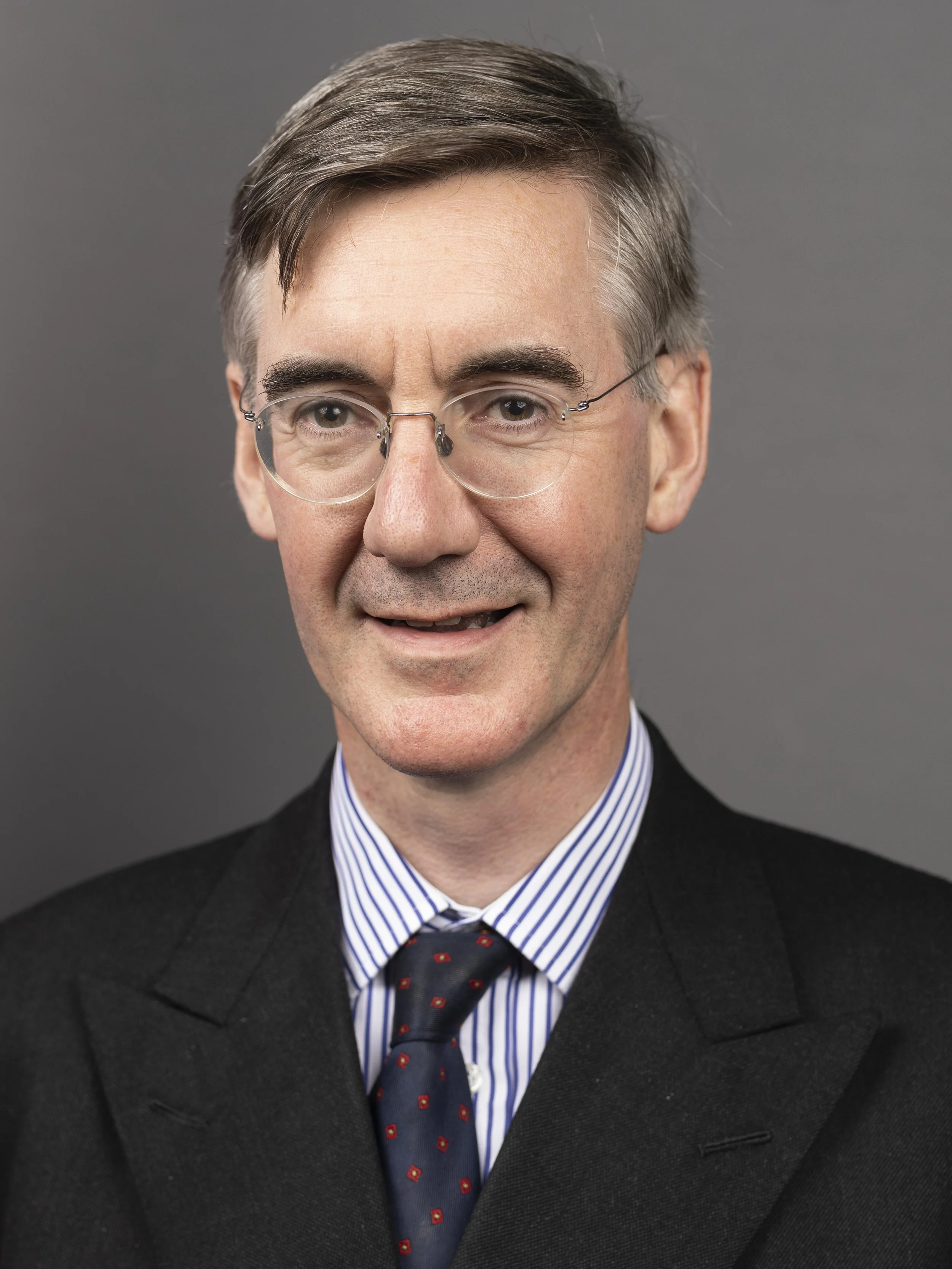
Jacob Rees-Mogg is a British politician who served as a member of Parliament and Leader of the House of Commons.
The Honorable Member of Parliament for the 18th Century
Contents
Max Raskin: Which of your father’s books had the biggest impact on you?
Jacob Rees-Mogg: I think it is The Reigning Error, which I know you just mentioned before the interview began. I first read The Reigning Error when I was studying economics as a schoolboy, and it has such a clear understanding of the problems of fiat currencies that have always recurred. I made this point, which I wouldn't make if it hadn't been for my father — since the end of the First World War, the three strongest performing currencies in the world are in order, the Swiss Franc, the US Dollar and the Pound, basically because they're the only three that have survived. Every single one of them has lost over 90% of its value, and the Pound has lost 99% of its value, whereas gold carries on buying things.
What was really interesting is that during the financial crisis, governments around the world put the printing presses on and everyone said, “Oh, lo and behold, nothing's happened. So we don't need to worry about money supply anymore. We can print lots of money and there's no inflation.” Well, that's not true, is it? Because 15 years later, we've had rampant inflation and the consequences of money printing.
What The Reigning Error points out is that all governments at all times will always reach for the printing press if they have that capacity. And that's why fiat currencies always devalue and you always have inflation.
What's great about the book? This may tell you that I'm quite the intellectual lightweight — it's a very short book and all the best writing in my view is short and to the point and can be understood by the non-professional reader.
And that's why my father was such a wonderful journalist — because he was an extremely clever man, and yet he was always able to explain things that could be understood by his much less clever children. And that's very important.
MR: You're jokingly known as the “Honorable Member of Parliament for the 18th century.” How do you feel about things like bitcoin and new technologies that allow you to do things like decentralize and take away power from the state. Are you a fan?
JRM: My pause before answering my favorite of my father’s books was whether it should be The Sovereign Individual, which he co-authored with Jim Davidson. It almost predicts bitcoin. And yes, I do try and keep abreast with this because I think the competition between the individual and government is absolutely fascinating.
And yes, I'm called the member for the 18th century, which I always enjoyed. I took as a compliment because I think you learn from your history. And that one thing that history tells you is that government and the family, government and religion are always in conflict because governments are jealous of their power. This seems to me to be something that one learns from history.
I'm fascinated by bitcoin as a rebellion against the state destruction of value. I am cautious on bitcoin because of the mystery about its founder and all of those things. I'd go back to my earlier point that one wants to understand precisely what one is investing in and explaining things to people so that it's easily understandable. Bitcoin’s foundation is too mysterious, but I think the effort to create a non-governmental value is really important.
MR: I teach a class on the subject at NYU’s law school — I’ll talk to you about it offline.
JRM: Excellent.
Berlin in London
MR: Did your dad have you read Mises and Hayek?
JRM: On the bookshelf behind me, I have a copy of Hayek that my father gave me.
MR: Did he know Hayek?
JRM: I think he may have met him, but I don't think he knew him well. He knew Isaiah Berlin quite well.
MR: Did you know him?
JRM: No, I didn't. Though Oddly, I ended up living in his rooms just off Piccadilly in Albany. He'd moved out and then I moved in, but I never actually met him. I did feel a link in a rather odd way. My father also gave me a copy of The Wealth of Nations.
Yes, those ideas were around in books, but I was probably much more influenced by the conversation with my father. I had the advantage that he distilled it all and could pass it on to me. The reading backed it up rather than challenging what I'd previously thought.
MR: Did he make a point to introduce you to important people in British intellectual circles? What was your dinner table like growing up?
JRM: It was very political. My father was editor of The Times when I was born, therefore, he knew a lot of political figures. We had a lot of political visitors at the dinner table, and so yes, I was very lucky growing up to be surrounded with interesting people, but more political than philosophical.
MR: Did someone make an impression on you when you were younger?
JRM: Oh, goodness. It's hard to pick individuals out, but the people who were the most interesting were the clever people who could be bothered to talk to children, which is always a great sign.
Oddly, Ted Heath was very nice to children.
I also had a wonderful godfather called Henry Hobhouse who wrote a really important book called Seeds of Change, about the effect on history of different crops and how they had been influential. He, though formidably intellectual who would take no nonsense from adults if they were making a bad argument, was absolutely delightful to children. People like that.
MR: I know your daughter is involved in Reform — what is your attitude toward children? Do you like talking to kids?
JRM: It depends what age, but teenagers, yes. I find one learns a great deal from talking to children and what they're interested in. During the general election campaign, my daughter kept me fully up to date with how Reform and the Labour Party were getting their message across effectively on TikTok when the Conservatives weren't. Now, I wasn't looking at TikTok myself, and children are helpful in that regard.
Also, children are wonderfully outspoken. I always loved going to schools in my constituency whilst I was an MP, and you would get the most rigorous questioning from primary school pupils. Once they're teenagers, they're a bit more diffident, but the 9-, 10-, 11-year-olds would say to you, "How much do you get paid?" My favorite was, "Does your father approve of you being here?” When I was about 50. The way children think is so interesting and unexpected and it has great charm.
Dress British, Think British
MR: You are probably the most British person alive. I interviewed Richard Dawkins and you make him look like Tony Soprano. But what’s the least British thing about you?
JRM: Well, I'll give you two. First of all, just before we began this conversation, I went to make a cup of coffee, not a cup of tea — and I'm sorry I let everybody down on that. And the second is my grandmother. My father's mother was American, so I'm a quarter American.
MR: Do you have a specific kind of coffee you like?
JRM: I'm afraid I like Alta Rica, which is an instant Nescafé coffee. You just add the hot water and you're done. I can't be bothered with faffing around with grinding beans and all that stuff.
MR: Are you a feinschmecker about anything?
JRM: I wouldn't claim great expert, but I'm probably quite fussy about wine.
MR: What’s your favorite bottle?
JRM: Well, it would be Claret French Bordeaux, unquestionably. I will tell you the most delicious wine I've ever drunk in my life was the 1982 Cos d'Estournel, which I was given a glass of at a wine tasting I was invited to, and it was simply magnificent.
MR: Is there anything you don’t care about that people would think you’d have strong opinions on?
JRM: I'm very relaxed about most things. When visitors come to see me and they're not wearing a suit and tie, they always apologize, and I don't mind a bit. It's not for me to tell them how to dress. I'm very relaxed about letting most people get on with their own lives most of the time.
MR: Do you always wear a suit and tie?
JRM: I do, yes.
MR: You don't sleep in a suit and tie, correct?
JRM: No, I don't sleep in a suit and tie. You're quite correct…but otherwise…
MR: Do you ever just wear jeans and a T-shirt?
JRM: No, no. I was picking blackberries yesterday and I was picking blackberries in a suit and a tie.
MR: Are you serious?
JRM: I'm absolutely serious, yes.
MR: That’s…yeah.
But you do have this American streak in you. You're much more independent in your thinking than the average Brit.
JRM: When I was an MP, I thought the point of being an MP was to think about things and argue about things and discuss things. I’ve never been very good at taking the party line. I think the party line is quite boring.
MR: Who in American politics is your beau ideal?
JRM: My real U.S. political hero is Teddy Roosevelt — such an exciting and dynamic figure. I read a biography on him over twenty years ago and admired his ability to do things which is so rare in politicians. If you want me to go right back into history, I think Alexander Hamilton is enormously interesting and admirable.
MR: But he was the father of American inflation.
JRM: But he's also the father of creating an America that wouldn't have happened. Hamilton understood that if you put the national debt together, you create an America. That is so, so important. So I think without him, you don't have the power of the United States.
MR: I interviewed Lord King, and he had a bust of Hamilton in his office.
JRM: Oh, yes.
Well, I'm an admirer of Mervyn King's. I think he's the last governor of the Bank of England who actually had any clue as to what he was doing.
So I think Hamilton. Obviously, Ronald Reagan is the most remarkable and important figure. Ronald Reagan and Margaret Thatcher rescue our respective countries from terminal decline.
MR: I would expect you to have said more cantankerous, like a Ron Paul or Bob Taft. Your answers are very institutional.
JRM: Okay. That's a fair point.
MR: Are you fundamentally an institutionalist?
JRM: No, I'm not. I think institutions fundamentally let people down. I'll draw one exception. As far as the Catholic Church is concerned, there I am an institutionalist. But I think political institutions become very sclerotic and very consensus-orientated, and you have to be very careful of political consensus.
Tired of London, Tired of Life
MR: For someone who has never been to London, where do you recommend they go eat?
JRM: An American in London probably stays in Claridge's, and you can't go wrong eating there.
But if you want to see a little bit of England tucked away where when the Tories are in government, you'll see half the cabinet eating — you’ll want to go to Wiltons in Jermyn Street. It's a fish and game restaurant. The service is immaculate, absolutely charming, and the food is superb.
MR: What's your favorite thing to order there?
JRM: I almost invariably have the Dover sole.
MR: And are you a creature of habit?
JRM: I have a boring repertoire of food that I eat.
MR: What do you have for breakfast?
JRM: I don't eat breakfast.
MR: Really?
JRM: No.
MR: I don't eat breakfast either. Do you snack during the day?
JRM: No.
MR: Do you nap during the day?
JRM: Almost always, yes.
MR: How long is your nap?
JRM: Oh, very short. If after this meeting I would drive for a couple hundred miles, I would have a ten-minute nap before setting off.
MR: Do you drive yourself?
JRM: I routinely drive myself, yes.
MR: Do you nap in your suit?
JRM: Yes, yes. Churchill, I think always said, "You should get ready for bed." I don't. I just put my feet on a stool, lie back and close my eyes and go sleep for 10 minutes…
MR: …and think of England.
JRM: And think of England. And Bob's your uncle, yes.
MR: I think I know what that means. I'm the least British person I know.
15th Century ChatGPT
MR: You love cars and cricket?
JRM: I do, yes.
MR: Is there anything else people don't know that you enjoy?
JRM: I've got a modest collection of antiquarian books, which I am fascinated by and like collecting.
MR: What are some of the books that you're most proud of?
JRM: The book I'm most proud of is a first edition of Thomas à Kempis’ Imitation of Christ, which I particularly like because it's imperfect. The last gathering of it is in manuscript, and the manuscript is dated 1493. You’ve got the printed bit, which is 1470-something, and then they realized that it was incomplete as they bound it, and they did the final binding in manuscript.
The fact that it's imperfect means that top book collectors wouldn't be interested. But to me that this was written so early on, I think adds to it and makes it a more romantic copy of the book. And it is of course, such a great, great work. That is the one book that I would probably rescue in a fire.
MR: He wasn't British, right?
JRM: No, no, he wasn't British.
The text is in Latin, so I can't actually read the text. But I can translate the text with ChatGPT. It's absolutely brilliant. My early books that are primarily in Latin used to be completely inaccessible, but you can take a photograph of them, put them into ChatGPT, and out comes a very satisfactory translation.
MR: Do you like ChatGPT?
JRM: I think it's magnificent.
MR: Do you think it's going to kill us all?
JRM: No, no. Everybody's always thought every new technology was going to kill us all. I think they believed that if you went faster than 20 miles an hour on the railways, you would suffocate. There’s always been something about why the latest technology will kill us.
MR: Well, if you were sitting in Hiroshima in 1945, you would've been right about the atomic bomb.
JRM: If you were a Frenchman in Agincourt in 1415 facing the longbow…
Cheap Chocolate, Expensive Everything Else
MR: Where are your glasses from?
JRM: They're from an optician in the King's Road.
MR: The big double-breasted suits, do you get them from the same place?
JRM: Yes. They come from a tailor called Henry Poole.
MR: And your ties?
JRM: Randomly. Quite a lot of them are from New and Lingwood if I bought them myself. But people give me ties. One of the nicest things that happened to me, I was in the Marylebone High Street looking for a taxi and a chap who ran a tie shop came running out and said he admired my work and asked if he could he give me a tie. So my ties sometime come from people who are kind enough just to give them to me in the street.
MR: What about your shirt and shoes?
JRM: Oh, gosh. Well, the shirts are from a chap called Sean O'Flynn, and the shoes come from Foster & Sons, who were in Jermyn Street but have now moved. They're not bespoke. I'm afraid, I'm too much of a skinflint or too poor to afford bespoke shoes. They're off the peg.
MR: Are you an easy person to shop for? What do your kids get you for presents?
JRM: My children give me bars of chocolate. Cadbury's dairy milk, a packet of Mars Bars, those things. I like children's chocolate, really rather, than posh chocolate. I much prefer a Cadbury's Crème Egg to some posh chocolate.
MR: What’s your favorite thing to do in America?
JRM: I've been to New York many more times than to DC. I love coming to America because there's something so positive, so determined about the American attitude. You come into New York from JFK and you just see this great city looming up ahead of you, and it's such a testament to power and capitalism. You see that raw power that Americans have and use so well.
I love the friendliness of American people. The British are true to our stereotype — relatively standoffish — but Americans are incredibly welcoming and helpful and there's a great kindliness.
Years and years ago, I did a little bit of volunteer work for the Pete du Pont campaign when he was running for the Republican nomination. How old was I? I was 18 at the time. And I arrived in Delaware. My baggage had got lost, and there was this lady who just sorted everything out for me and invited me to stay with her for the night. Just incredible kindliness and openness that I love about American society.
MR: That’s a bizarre person for you to have campaigned for.
JRM: It was through Jim Davidson, who co-authored the book with my father. A friend of his was du Pont's campaign chairman.
MR: I think you would be a good American. I could see you living out West, hunting and being an American renegade or outlaw. Is that you?
JRM: I think if tax rates get even higher in England, I might have to do it…
MR: We would welcome you with open arms.
JRM: Oh, thank you.
Stoop and Conquer
MR: In America the more conservative you are generally the more you dislike and distrust the federal government — I’m thinking of Waco, for instance. In England, the more conservative you are, the more you support the monarchy. Is that breaking down?
JRM: Having been in government, the reason to dislike government is not that it is conspiring against you, but that it's incompetent. There isn't a wicked conspiracy. I think the government haters in the US are much more conspiracy minded. I just don't think that's right. I don't think governments are competent enough to run those conspiracies.
In the UK, there is an influence of the libertarian Right, that is suspicious of government full stop.
MR: We're not talking about the Levellers, we’re talking about something more recent, right?
JRM: Yes, but bear in mind, big government is a relatively recent phenomenon. Prior to First World War, the touch of government is very slight, and A.J.P. Taylor could write that in 1914, the only interaction that the average citizen had with the government was when he went to the post office. That was about it. And now the government is involved in every aspect of people's lives, and that has created a feeling that this is too much, and it needs to be reduced.
MR: Were you a fan of Taylor?
JRM: I've tended to use him more as something to dip in and out of as a source book when I've been writing things or looking things up, rather than somebody I've read from cover to cover. What's interesting about him is his wild theories. I mean, the famous one that the First World War started because of the railway timetables. And I think it's great to bring history into that focus — that very often things happen because people have forgotten about something or are bound by something that in and of itself is unimportant. I suppose an early version of chaos theory.
MR: What are you reading right now?
JRM: I'm on volume three of the magnificent series on The Hundred Years War by Jonathan Sumption.
MR: And do you listen to podcasts?
JRM: I listen a great deal to audiobooks more than to podcasts.
MR: Are you a fan of Twitter or any of the social media?
JRM: I'm on Twitter. Whether that makes me a fan of it, I'm not so sure. It's essentially a political tool of mass communication, rather than really looking at it for my sources of information.
MR: Churchill said of Lord Dalmeny, “He would not stoop; he did not conquer." Are you ever put in uncomfortable positions?
JRM: Well, the bit I do on Twitter, I thoroughly enjoy. I had great fun putting up something saying, "Donald Trump should become prime minister of the UK once he finishes being president." And the Left were absolutely furious. They get so cross. I’m afraid the Left have no sense of humor, so they assume everything you say is serious. And I thoroughly enjoy using Twitter to get a reaction out of tiresome people.
MR: Do you enjoy being on TV now?
JRM: I've always quite enjoyed being on TV. I very much enjoyed doing my own program because you set the agenda.
MR: If you could have anyone on, who would you like to have on?
JRM: Well, if Donald Trump's free, that would be great.
I'll tell you, he keeps on having his press conferences at eight o'clock in the evening British time. So I'm afraid I do cheat and say I'm having now, as my special guest, the President of the United States. Obviously I'm not, but I'd love for him to come on. Boris has kindly joined me.
MR: What about historically? Is there anyone who you would love to have had on?
JRM: My screen for this interview is propped up against the multi-volume biography of Benjamin Disraeli. So let's start with Benjamin Disraeli. Margaret Thatcher would be pretty good. My great hero from the past is Alfred the Great, who I think is effectively the founder of England and thereby the United States. A fundamentally important figure. My other great hero is John Fortescue who sets out the fundamental tradition of Britain, and it ties in with the common law: the state, in his terms the king, is under the law, whereas the state in other countries is the law.
I'd like to interview both the Pitts. Wouldn't it be fun to have Lord North on and ask him what he thought about his American policy in retrospect?
MR: Are you excited for Ken Burns’ American Revolution? Do you ever watch the Ken Burns documentaries?
JRM: No, I don't.
MR: Do you know who he is?
JRM: No. I don't know who Ken Burns is.
MR: He’s the equivalent of our Kenneth Clarke. He did a magnificent documentary about the American Civil War. You got to listen to Shelby Foote, he was a contemporary of Faulkner. Do you know Faulkner?
JRM: No, I don't. Tell me who he is.
MR: He was a famous Southern novelist and writer. I think he won a Nobel prize. But you’ll love Foote. I’ll send you some thing.
JRM: Oh, I'd love that, I'd be really interested.
I know much too little about America, but I listened to the Caro biography of Lyndon B. Johnson. Oh my goodness. That is interesting.
I listened to it in the car and all the children were there, but Mary particularly. She was only about 9 or 10 at the time, and she would suddenly ask me questions about the electoral system in Mississippi. I thought she was asleep in the car, but she was absolutely glued to it too.
Sixtus
MR: Do you pray or go to church every day?
JRM: I certainly pray every day — I don't go to church every day. If I'm in Somerset, I've got a chapel and I go to the chapel every day, which is a great privilege.
MR: How many of the popes have you met?
JRM: Oh, none. I've never met a pope.
MR: Really? That's shocking to me.
JRM: Popes are busy. They don't have time to meet people like me.
MR: When you walk down the street in England do people know who you are?
JRM: Reasonably, yes.
MR: Do you wish you were not?
JRM: I don't mind one way or the other. I mean, it's just as it is.
England is a very safe country. I can just pootle about quite happily in England. I get stopped for the odd selfie. It's quite funny. I did get stopped for selfies in Parliament Square — I did a couple, and then some tourists started asking me. I didn't think they had any idea who I was at all. But because somebody else had asked, they just thought I was like one of those telephone boxes that people take their photograph in. I rather enjoyed this. I thought it was faintly ridiculous.
MR: Have you ever taken a selfie with someone where you requested the selfie?
JRM: Not sure. I do have a selfie with Alistair Cook, who was the former captain of England in cricket, but I think we both agreed to take one. I certainly didn't go up to him and say, "Can I have a selfie?" I'm a great admirer of his.
But no, I don't tend to ask people for selfies. I don't particularly like selfies of myself because I've got a very, very large nose. And if you have the camera that close, all you get is this huge conk.
MR: Wait, do you enjoy traveling?
JRM: Most of the traveling I've done has been on business, rather than holiday. I love traveling when you've got a purpose for traveling. If I'm going on holiday, I'd frankly rather be at home in Somerset.
MR: Are you a homebody?
JRM: Yes, I'm basically a homebody.
MR: Where's your favorite place to eat in Somerset?
JRM: Oh, at home.
MR: So you don’t have this in England, but we have something called the death penalty here in America.
JRM: I think I know your question: If I were on death row because I'd mysteriously become a German spy in the Second World War, what would I have? I would have some smoked salmon to start with because I'm going to have my foie gras with the beef — the Tournedos Rossini — pomme soufflé for my main course, and then a chocolate soufflé to finish with…which they used to do beautifully in Claridge's when I used to get there more often than I now do.
MR: And the drink is the wine that you were drinking?
JRM: If you could get hold of any of it the 1982 Cos d'Estournel. I mean it's almost worth committing a capital offense for to get this dinner.
MR: I want to finish by talking about children. I have to ask about the name “Sixtus.”
JRM: Yes.
MR: Was that a fight with your wife?
JRM: No, she was quite happy with Sixtus as a name. Pope Sixtus II is an interesting martyr, he's in the canon, and so on and so forth. Pope Sixtus V rebuilds Rome — quite a remarkable man.
I'm not sure one should allow puns in one's children's names. But we did. Calling the six child, “Sixtus,” amused me, and it doesn't mean “sixth.” That would be “Sextus.” “Sixtus” means “polished.”
MR: Right?
JRM: Yes. It's a Greek derivation on the Latin one. But nonetheless, it made a pun, and the pun amused us, and it related to a couple of very distinguished popes. I'm afraid that's how it came about. Sixtus is now eight, so I'm afraid I keep on telling him we've got to change his name to Octavius.
MR: Does he have a nickname?
JRM: No. He did briefly because one of his brothers couldn't say Sixtus when he was little, but that died out actually.
MR: What was the nickname?
JRM: That was Igoo.
MR: Igoo?
JRM: Igoo. That was, I think the best Alfred, who's only a year older than him could manage. And so he was Igoo for a bit. But that's died out.
MR: When you yell is it, "Sixtus come down!" Is that what you say?
JRM: Yes.
MR: They always say that Muhammad is most popular boys’ name in England right now. Sixtus is probably not as high on that list.
JRM: Every so often the Daily Mail has a list of all first names that have been used in the last year and appeared on birth certificates. And every so often I put in Sixtus to see where that ranks. It usually ranks with a big fat zero. So my effort to make Sixtus a more popular name has not been successful.
Cult Figure
MR: Are you a cult figure? Your dad is a bit of a cult figure.
JRM: I am glad that you're leaving off the “oc” before that. I'm definitely not an occult figure.
MR: The “ac” — Aleister Crowley.
JRM: I know very little about the occult. I'm glad to say.
MR: He went to Cambridge.
JRM: It's what you would expect from Cambridge.
It’s not really for me to say whether I am a cult figure, is it? I'm routine political figure of the early part of the 21st century.
MR: Are you going to return into politics?
JRM: I'd love to get back into politics, yes.
MR: Do you think you could be prime minister?
JRM: No.
If you look at the next election, I think Labour will find it very hard to win. The candidates will be Nigel Farage and Kemi Badenoch or whoever the leader of those two parties is and I won’t be one of those, and so no I won’t be Prime Minister, but I'd love to get back in as a member of Parliament.
MR: Is there any chance you would join Reform?
JRM: I want the Right to unite. What Donald Trump’s been so clever at doing is uniting all the right behind him in America, including some pretty soggy Republicans, who bought into his agenda in the end, partly because they realized how bad the alternative was. And we both have first-past-the-post systems and in that system, you have to come together. So I want to remain as a Conservative and bring the Conservatives in Reform to some collaboration.
MR: Would you have a name of a new party?
JRM: No, not particularly. All of those things can be worked out at a later stage.
MR: What would be your favorite name for a party?
JRM: Oh, the Tory Party would suit me just fine.
MR: You would call it the Tory Party instead of the Conservative Party?
JRM: I'm quite happy to be the Tory Party.
MR: The Neo-Tory Party.
JRM: Yes, I'm not so keen on “neo.”
MR: The Paleo-Tories.
JRM: Paleo, I like. Yes. That's a good idea.